Chianti vs Sangiovese: What's Actually Different
Chianti is a place-based, legally defined wine, while Sangiovese is a grape: standard Chianti must contain at least 70% Sangiovese, and Chianti Classico at least 80%. That makes “Chianti vs Sangiovese” a comparison between a regulated wine and its main ingredient, not competing grapes.
The usual advice to choose Chianti for structure and Sangiovese for something simpler misses the point. A bottle can be both Chianti and entirely Sangiovese. Your better buying questions are where it came from, how it was made, and whether its style fits your dinner.
Table of Contents
- The Question Most People Get Wrong
- Chianti and Sangiovese Defined in Plain English
- How Much Sangiovese Is Actually in Chianti
- Chianti vs Sangiovese on the Palate
- Why Sangiovese Tastes the Way It Does
- Why Vintage and Subzone Now Matter More
- Pairing Each Style With Real Meals
- Which Bottle to Buy When
The Question Most People Get Wrong
A wine list puts Chianti beside Sangiovese, and suddenly they look like rivals. That's understandable. Restaurants and shops often mix regional names with grape names, leaving you to sort out what each label really tells you.
But the names answer different questions. Chianti identifies a regulated wine from Tuscany. Sangiovese identifies the grape that forms its foundation, a distinction explained by the Chianti consortium's guide to Sangiovese and its companion grapes.
What each name tells you
| Name on the bottle | What you're learning | What you still need to check |
|---|---|---|
| Chianti | A defined origin and production framework | Producer, blend, vintage, and aging |
| Chianti Classico | A separate appellation with its own rules | The producer's style and the bottle's maturity |
| Sangiovese | The grape identity | Origin, blend details, and winemaking |
Think about a shopper choosing between Chianti and a bottle labeled Sangiovese. The Chianti name gives that shopper a regional framework. The Sangiovese name doesn't, by itself, identify the same place or production rules.
Neither label settles whether the wine will feel light, powerful, smooth, or gripping. Neither settles whether it's a bargain. Those answers depend on the actual bottle, not which name looks more familiar.
Shopping rule: Compare bottles, not categories that overlap.
Stop looking for an automatic winner
You might prefer a bright Chianti with pasta and a fuller varietal Sangiovese with grilled meat. You could also prefer the reverse. The label starts the conversation; it doesn't finish it.
The useful question isn't “Which is better?” It's “What does this bottle promise, and what remains unknown?” Once you separate grape identity from regional identity, you can read a shelf without treating every unfamiliar wine name as a new grape to memorize.
Chianti and Sangiovese Defined in Plain English
An appellation is a legally defined wine name tied to a place and production rules. For Chianti, that means more than a Tuscan address. Producers must follow requirements governing how the wine is made and identified.
DOC and DOCG are Italian classifications for regulated wines. DOC establishes controlled origin and production standards. DOCG adds the traditional guaranteed designation, but neither abbreviation promises that you'll personally love the flavor.
The place has a history
On September 24, 1716, Cosimo III de' Medici, Grand Duke of Tuscany, issued a proclamation defining Chianti's production boundaries and regulating its origin, production, naming, and commercial conditions; Chianti later received DOC status in 1967 and DOCG status in 1984, as documented in the Chianti consortium's appellation history.
That history explains why Chianti isn't a nickname for a grape. Its identity developed around a place and the conditions under which producers could use its name.
Sangiovese, meanwhile, is a red grape grown across central Italy. It forms the foundation of Chianti and appears in other important Tuscan wines, including Chianti Classico, Brunello di Montalcino, and Vino Nobile di Montepulciano.
Similar ingredients, different identities
Don't treat those regional names as interchangeable. Knowing they share Sangiovese helps you recognize a family connection, not a single flavor or a common set of rules.
- Chianti gives you a defined regional wine category.
- Chianti Classico is a separate appellation, not just the deluxe version of ordinary Chianti.
- Brunello di Montalcino and Vino Nobile di Montepulciano belong to the wider Sangiovese conversation, but retain their own identities.
- Sangiovese on a label tells you about the grape, so look elsewhere on the bottle for its origin.
If grape names and regional names still blur together, keep a grape varieties chart handy while browsing.
You don't need to pronounce every name perfectly. You need to recognize whether it identifies an ingredient, a place, or a regulated wine. That's enough to ask a useful question at the counter.
How Much Sangiovese Is Actually in Chianti
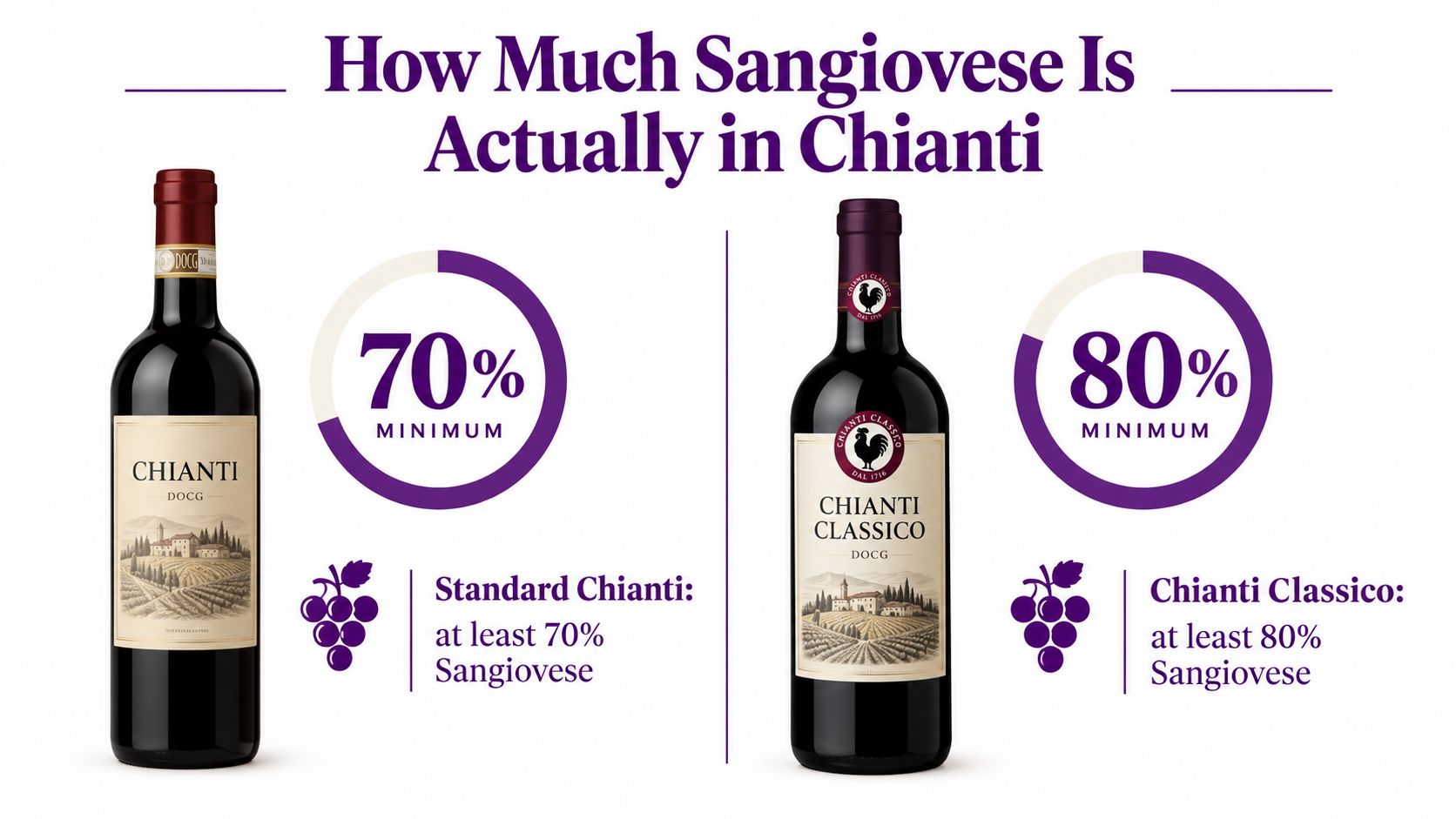
The label names answer different questions: Chianti identifies a regulated wine from a place, while Sangiovese identifies a grape. The percentages show how much of that grape the rules require, not whether one bottle is better than another.
Standard Chianti must contain at least 70% Sangiovese and may be made entirely from it. Chianti Classico allows 80–100% Sangiovese. The Chianti Classico regulatory timeline outlines the legal distinction and how Classico's blend rules changed.
The minimums are easy to compare visually.
What happens to the remainder
Where the rules allow, producers can blend in approved companion grapes to shape a wine's body, color, aroma, and texture. Canaiolo is one example. A blend doesn't make the wine less authentic; it's one way to craft a wine within the appellation's requirements.
For Classico, both the defined production area and approved grape composition apply. Its production code also limits the wine yield from grapes to 70%. That is a production limit, not the permitted share of a grape in the blend, as the Chianti Classico production code explains.
The two percentages measure different things. Grape percentage describes what goes into the blend. Wine yield describes how much wine producers obtain from the grapes.
Why older explanations sound different
Classico's rules have changed over time. Its permitted Sangiovese range shifted from 50–75% to 75–90% in 1984. Entirely Sangiovese wines became permitted in 1996, and the minimum rose to 80% in 2006, when white grapes were removed from its blend, according to the regulatory timeline.
That history explains why older descriptions may mention Trebbiano and Malvasia. Those references don't describe today's Classico rules, and Classico's ban on white grapes shouldn't be mistaken for a rule about standard Chianti.
When you're comparing bottles, check the back label or producer's technical sheet for the actual blend. The legal minimum sets the floor, not the recipe. Confirm the full appellation, too, because Chianti and Chianti Classico have different requirements. Then treat the percentage as one piece of context alongside the vineyard conditions and winemaking.
A producer using only Sangiovese and one using a blend can both make compelling Chianti. The useful question is what each producer chose, not which bottle wins a purity contest.
Chianti vs Sangiovese on the Palate
The labels name different things, so the wines won't sort neatly into two taste profiles. Chianti is a regulated wine from a place; Sangiovese is a grape. A bottle labeled Sangiovese may show the grape on its own, while Chianti's flavor depends on its permitted blend and the producer's choices.
Acidity is the mouthwatering sensation that can make a wine feel refreshing or sharp. Tannin creates a drying grip on the gums, like strong tea. Body describes how light or weighty the wine feels. These are separate clues, not one measure of whether a wine is “strong.”
In the glass, look for tendencies rather than rules:
| Trait | Standard Chianti | Chianti Classico | Varietal Sangiovese |
|---|---|---|---|
| Acidity | Sangiovese brings freshness; blending can change the balance | Often central to the wine's structure | A defining feature, shaped by ripeness |
| Tannin | Other grapes may change the grip | Sangiovese-led, though intensity varies | The grape's grip may feel more direct |
| Fruit character | Red fruit, with possible contributions from the blend | Often a Sangiovese-centered red-fruit profile | Red cherry, with expression shaped by site and ripeness |
| Body | Varies with blend and winemaking | Not necessarily heavier than standard Chianti | Can range from light to full |
| Oak influence | Depends on the producer | Depends on the producer | Depends on the producer |
Standard Chianti rules allow white grapes up to 10% and Cabernet varieties up to 15%, alongside a Sangiovese-led blend, according to the Chianti consortium's production and style guide. Those allowances help explain why standard Chianti doesn't have a single fixed texture or flavor.
A varietal Sangiovese can put the grape's acidity, tannin, and cherry character in clearer view. A Chianti blend may soften or broaden that impression, but blending does not guarantee softness, and a wine made entirely from Sangiovese need not feel aggressive.
Classico's tighter blend framework doesn't mean every bottle tastes more intense than every standard Chianti. Winemaking choices can outweigh that distinction.
You're tasting a finished wine, not a grape percentage.
For a fair side-by-side tasting, choose bottles with similar producer notes on maturity and oak treatment. Otherwise, differences in age or oak may shape what you taste more than the category or grape.
Notice the finish first. Does it leave your mouth refreshed or feeling sharp? Then check the tannin: is the grip gentle, persistent, or distracting? Keep body separate from tannin, since a light wine can still leave a firm drying sensation.
Those details give you useful words for choosing your next bottle. “Fresh, with moderate grip” tells a shop employee more than “I think I prefer Sangiovese.”
Why Sangiovese Tastes the Way It Does
Sangiovese's flavor is shaped by the season and the choices made in the cellar, not just by its familiar cherry notes. That helps explain why one bottle can taste bright and savory, while another feels rounder or firmer.
Acidity and tannin create different sensations. Acidity makes your mouth water, like a squeeze of lemon with food. Tannin leaves a drying grip on your gums. A wine can have lively acidity and gentle tannin, or the reverse, so “too strong” doesn't tell you which quality you're reacting to.
Ripeness changes the balance
Research on climate suitability for Sangiovese identifies an optimal harvest range of 24.08–26.23 °Brix, corresponding on average to roughly 13.5–15% potential alcohol, alongside an optimal acidity range of 5.50–7.50 g/L (research on climate suitability for Sangiovese).
°Brix measures dissolved solids, mainly sugars in this context. Potential alcohol estimates the alcohol those sugars could produce during fermentation. It is not the measured alcohol in a finished bottle.
Those figures help explain balance, though you don't need them to choose a wine at dinner. Fruit picked before it is fully ripe can taste sharper and more angular. Very ripe fruit can bring more alcohol and less of the freshness often associated with Sangiovese.
Ripeness and grip are separate clues
Skin and seed condition affects how much tannin is available as grapes ripen. Extraction is the winemaker's process of drawing material from skins and seeds into the wine. Harvest timing and cellar choices both shape the final texture.
So cherry flavor alone won't tell you how firm a Sangiovese will feel. Try this small tasting exercise: after a sip, notice whether your mouth waters, then whether your gums feel dry. Those clues separate acidity from tannin. Next, look for recognizable cherry character and a savory finish that seems suited to food rather than sweet fruit.
For a closer explanation of how grape, growing conditions, and winemaking shape flavor, read this guide to why wines taste different.
You don't have to diagnose the vineyard. Notice which mix of freshness, grip, fruit, and savory character you enjoy, then use those words when choosing your next bottle.
Why Vintage and Subzone Now Matter More
A familiar appellation isn't a promise of identical flavor every year. Vintage means the harvest year, and the growing conditions during that season affect what the producer has to work with.
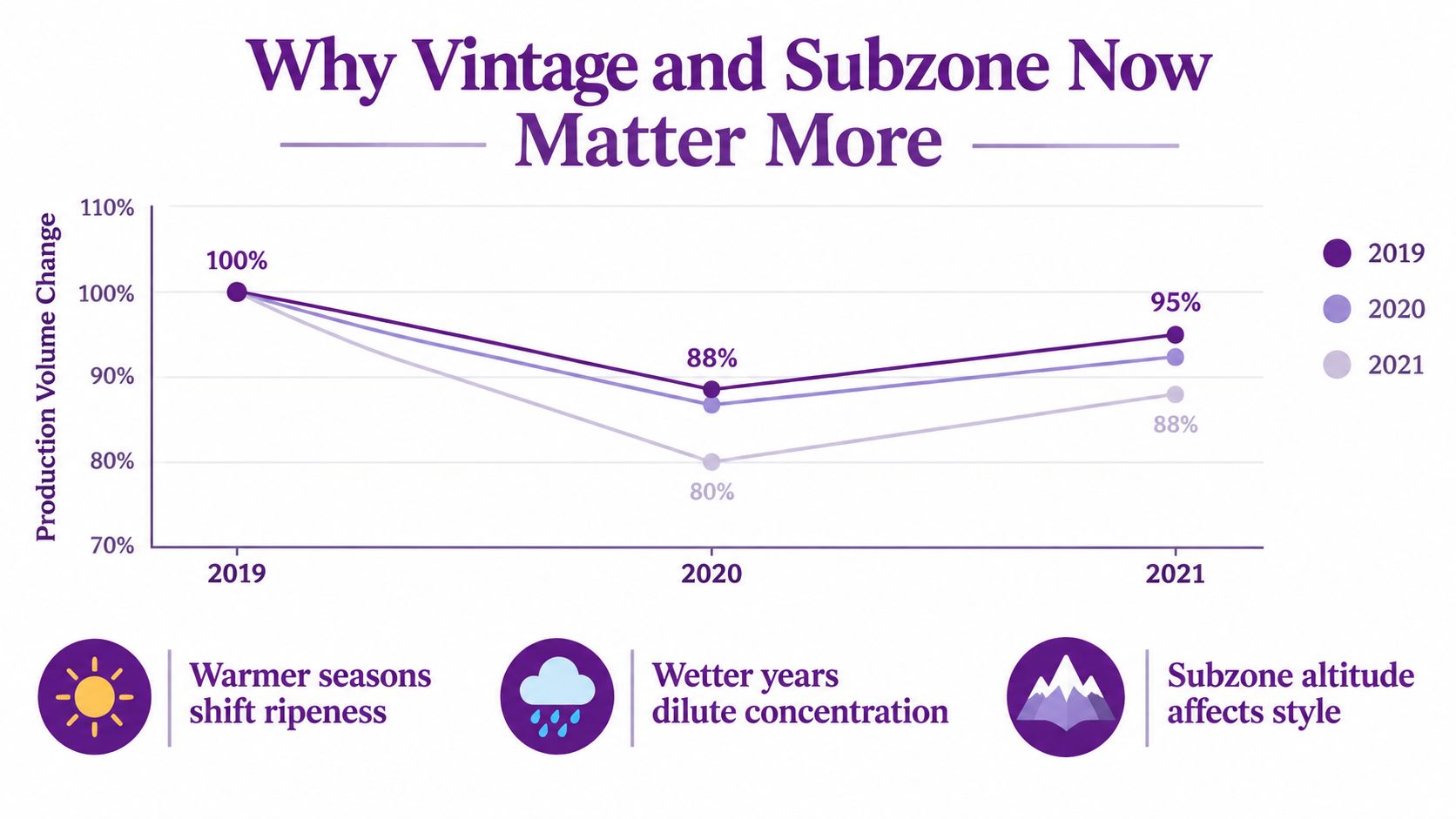
Chianti production was reported at 619,000 hectoliters in 2025, compared with 805,000 hectoliters in 2024, with seasonal conditions and reduced yields linked to the lower volume in WineNews's report on the new Chianti and Morellino vintages.
Lower output doesn't automatically mean worse wine, better wine, or a particular flavor. Production volume describes quantity. You still need information about the finished bottle.
The following graphic illustrates vintage variation, but its historical series isn't a verified production record and shouldn't be used to rank harvests.
Place gets more specific than Tuscany
A subzone is a smaller recognized area within a broader appellation. Rufina and Colli Senesi, for example, have distinct geographic identities within Chianti.
Local conditions can influence ripeness and freshness. The climate research discussed earlier helps explain why a broad regional label can't tell you everything about a vineyard's growing season.
Don't turn that into another rigid shortcut. Cooler origin doesn't guarantee a delicate wine, and warmer conditions don't guarantee a heavy one. Producers still choose when to harvest and how to make the wine.
Questions that help at the counter
- Origin. “Where within the appellation does this bottle come from?”
- Vintage. “Does this harvest taste fresher or riper than the producer's usual style?”
- Producer. “Is this made for brightness, or for a fuller, more developed feel?”
Order by preference: Ask for a bright, savory bottle with comfortable tannin, then let the seller match that description to the available vintage.
That's more useful than demanding the “best year” without saying what you like. Your dinner and preferences matter more than a blanket vintage verdict.
Pairing Each Style With Real Meals
Start with the meal, not an imaginary hierarchy of wine. Tomato sauce, grilled meat, mushrooms, and aged cheese all give you useful ways to think about Sangiovese's acid-and-tannin combination, as described in the climate research cited earlier.
Pasta and steak show the contrast especially well.
Pasta and pizza don't need a trophy bottle
For tomato-based pasta, I'd start with a young, fresh standard Chianti. You want a wine that stays lively beside the sauce, not one whose weight overwhelms a straightforward dinner.
For pizza, use the toppings as your guide. Tomato and cheese suggest the same fresh direction. If the pizza has a more substantial meat topping, consider a bottle with more body and grip, whether that's Chianti Classico or varietal Sangiovese.
These are starting recommendations, not rules. A fresh varietal bottle can be just as sensible as Chianti. The wine pairing chart offers a broader reference when the menu changes.
Meat, mushrooms, and cheese
With grilled red meat, I'd look for a structured Chianti Classico or firmer varietal Sangiovese. Protein and fat give that drying grip something to work alongside.
For mushroom risotto, I'd favor a savory bottle with freshness and restrained weight. Don't assume the most tannic option is the best one; you want to enjoy the mushrooms, too.
With aged sheep cheese, try a more developed Chianti or Classico. Salt, fat, and protein provide a useful counterpoint to the wine's structure, but you don't need the strongest bottle on the shelf.
For a visual companion to the meal-by-meal approach, use the video below.
- For an acidic dish, prioritize freshness.
- For a rich, protein-heavy dish, consider more grip.
- For a savory dish, avoid letting sheer weight become your only buying criterion.
The best practical test is simple: taste the wine, take a bite, then taste again. Choose the pairing you enjoy, not the one that sounds most impressive.
Which Bottle to Buy When
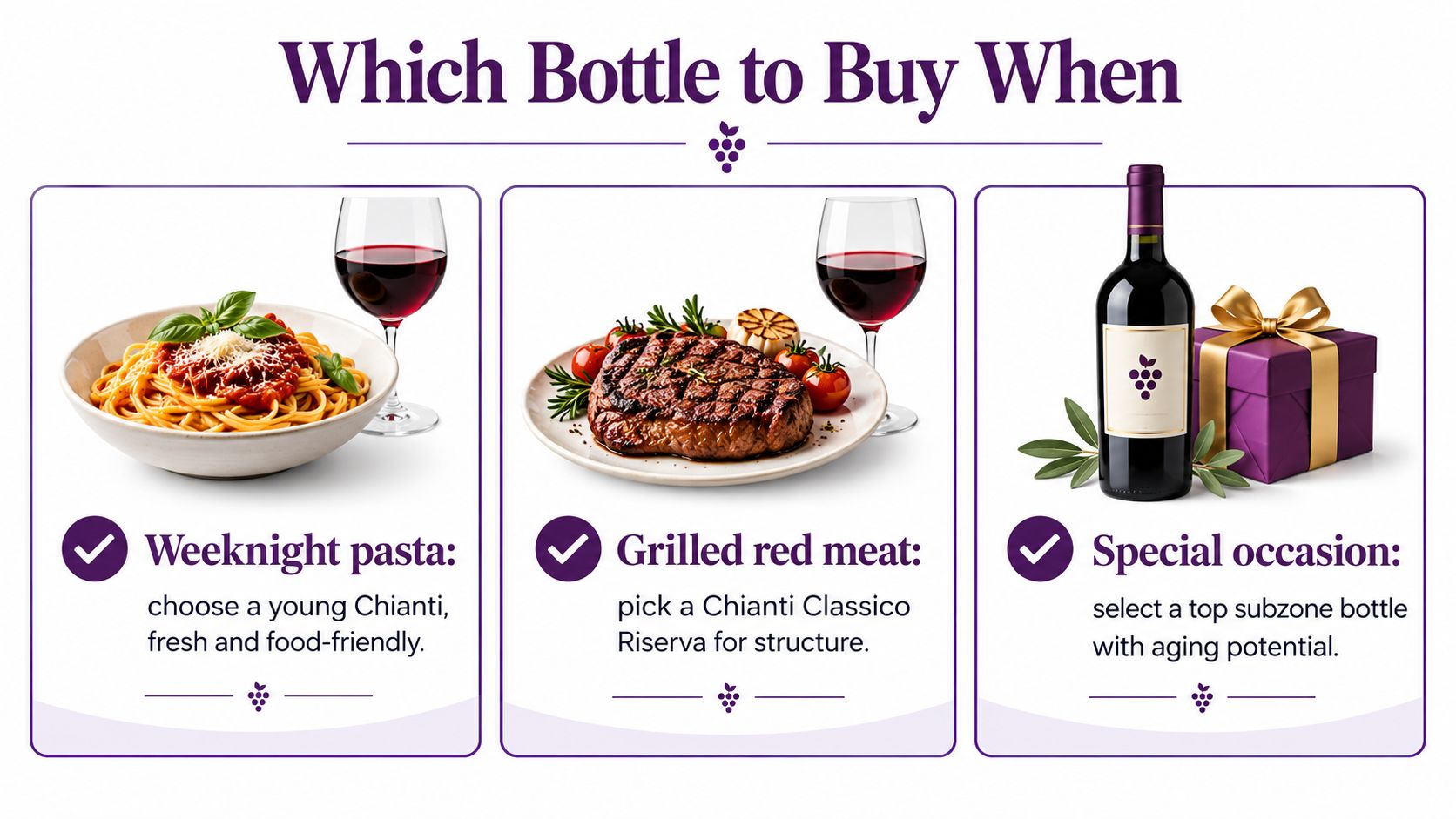
Buy for the occasion rather than assuming Chianti is always more serious or varietal Sangiovese is always cheaper. Neither name establishes value on its own.
For weeknight pasta, start with a young standard Chianti described as fresh and ready to drink. For grape-focused exploration, choose a varietal Sangiovese with clear information about its origin and winemaking.
Use this guide as a starting point, then check the individual bottle's style.
When maturity matters
Standard Chianti cannot be released before March 1 of the year after harvest, while Chianti Riserva requires at least two years of aging, counted from January 1 after harvest, including at least three months in bottle, according to Visit Tuscany's Chianti DOCG guide.
Basic Chianti Classico requires at least 11 months of aging, cannot be sold before October 1 of the year after harvest, and has a 12% minimum alcohol requirement, as explained in this Chianti Classico appellation guide.
Those rules give you meaningful context, not a guarantee of readiness or personal preference.
- For a Tuscan dinner, ask for a Classico that fits the main dish and is drinking well now.
- For a gift, ask about the recipient's tastes before choosing a prestigious name.
- For a milestone, consider Brunello di Montalcino, but confirm whether the specific bottle suits immediate drinking.
- For a fresher style, ask about vineyard origin and vintage rather than relying on the appellation alone.
Your next step is to pick a bottle whose producer, origin, and style you can identify. If you want help recognizing your preferences first, take the free wine quiz.
A to Wine offers a personalized, ongoing wine path with short daily lessons that take about 5 minutes, practice quizzes, and an AI sommelier. Visit A to Wine to practice reading labels like Chianti and Sangiovese, then use what you learn to choose your next dinner bottle with less guesswork.