How to Read Wine Labels Without Overthinking It
You're in the wine aisle with three minutes, ten bottles, and a headache. Skip the medals and fancy names. How to read wine labels comes down to a fast scan of the fields that tell you what's in the bottle, then ignoring the rest until they prove they matter.
The trick is simple, and a lot less glamorous than wine marketing wants you to believe. Check the producer, region of origin, vintage, varietal or blend, and ABV in that order, then use those clues to decide if the bottle fits what you want tonight. If the label lines up cleanly, buy with confidence. If it doesn't, put it back and move on.
Table of Contents
- Five Seconds on the Shelf What to Scan First
- Origin Vintage and Varietal The Consistency Check
- ABV Demystified What the Number Actually Tells You
- Marketing Words That Look Official but Aren't
- A Quick Method for Picking a Bottle You Will Actually Like
- Edge Cases Low ABV Wines and the New EU Disclosures
Five Seconds on the Shelf What to Scan First
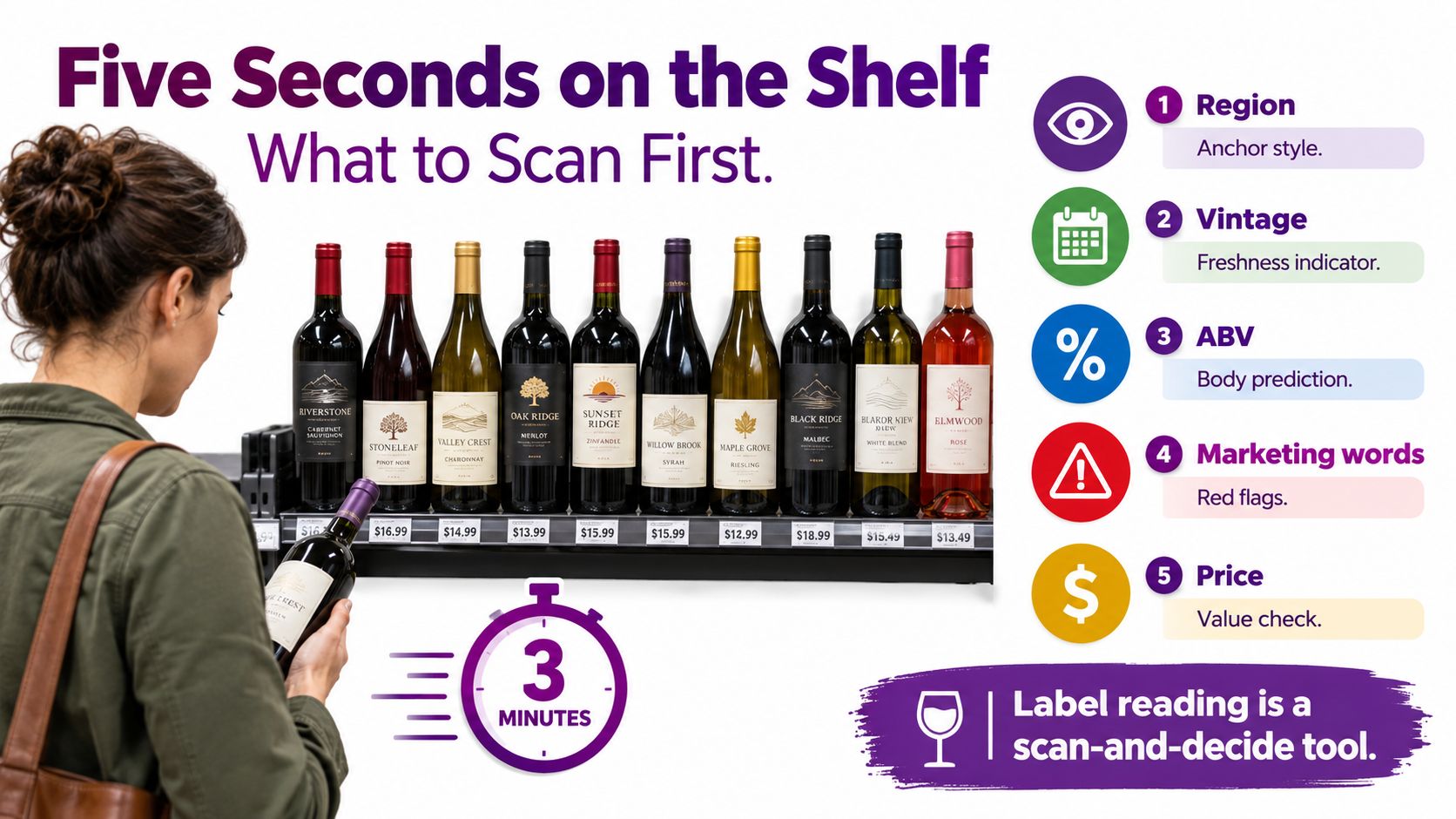
You're staring at a shelf with ten bottles and no patience for a wine lecture. Good. That's the right mindset. A label is a shortcut, not a test.
Start with the name at the top, the producer or brand. That tells you who made the wine and gives you a rough quality anchor. Then look for the region of origin, because place is the first big clue to style. After that, check the vintage, the varietal or blend, and the ABV. Those five fields usually tell you enough to make a smart guess before you ever pull the cork.
Practical rule: If the bottle gives you a clear producer, place, year, grape, and alcohol level, you already know most of the story.
The point isn't to memorize jargon. It's to decide fast. A bottle that says Mendoza, 2022, Malbec, 14% ABV is sending a very different signal from one that says Loire Valley, Sauvignon Blanc, 12% ABV. One leans fuller and riper. The other leans brighter and lighter.
That's why label reading works as a scan-and-decide tool. The front label can be loud, but the useful stuff is usually plain, legal, and boring in the best possible way. By the end of this, you should be able to walk into a store, glance at a bottle, and make a confident pick in five seconds.
Origin Vintage and Varietal The Consistency Check
Origin, vintage, and varietal are not three separate facts. They're one consistency check. If they line up, you're probably looking at a bottle that tastes like you expect. If one detail feels off, slow down and look again.
Start with place, then test the year
The region tells you the flavor baseline. Climate and local tradition shape what the wine can realistically be. A cooler place usually points toward sharper acidity and lighter fruit, while a warmer place usually means riper fruit and more weight in the glass. That's why the same grape can look completely different depending on where it was grown.
The vintage is the year the grapes came from, and it matters because weather leaves fingerprints. It matters more when the region has big year-to-year swings. It matters less when the climate is steady. Use it as a freshness and ripeness clue, not a scoreboard.
Then check the varietal. In places like France, Italy, and Spain, the label often leads with the place. In places like the U.S., Australia, and Chile, it often leads with the grape. That's not a style difference for the sake of style. It changes how you read the bottle. If the label says Chablis, you're reading a place name first. If it says California Chardonnay, you're reading the grape first.
Quick take: When origin, vintage, and grape all point in the same direction, trust the bottle more. When they fight each other, trust your caution.
| Field | Old World Example: Chablis | New World Example: California Chardonnay |
|---|---|---|
| What stands out first | Place | Grape |
| What the label suggests | Regional style and local rules | Grape-driven style |
| What to do with the clue | Look up the region if needed | Use the grape as your main anchor |
If you want a deeper grape-by-grape reference, this grape varieties chart is the kind of thing that saves you from guessing at the shelf.
ABV Demystified What the Number Actually Tells You
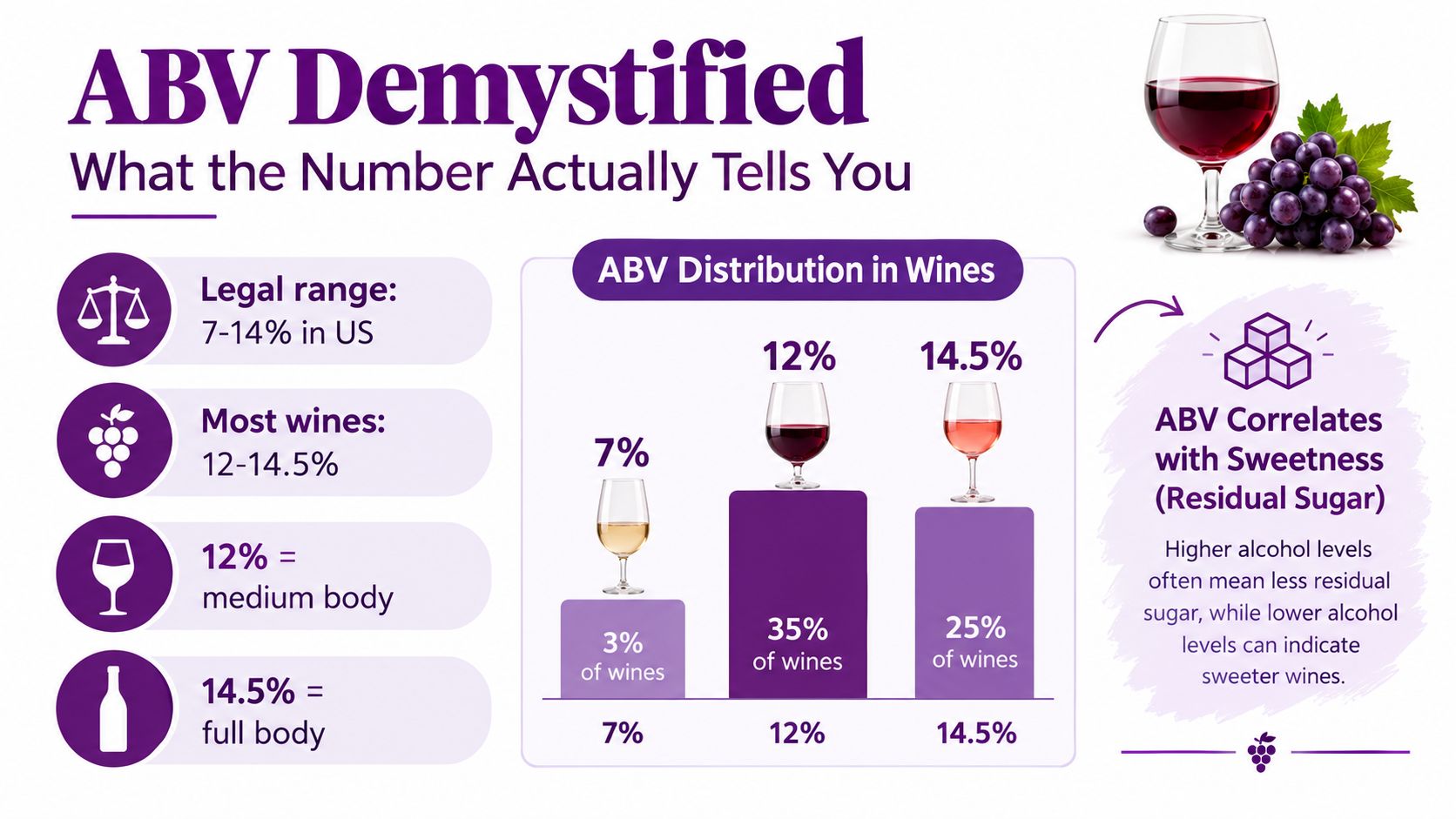
ABV is one of the most useful numbers on the label, and people ignore it way too often. They shouldn't. Alcohol tells you a lot about body, ripeness, and how the wine will feel in your mouth.
Read the number like a mouthfeel clue
In the U.S., wines over 14% alcohol by volume must state alcohol content numerically, while wines from 7% to 14% ABV may omit the number if the label uses the class or type terms table wine or light wine. Wines below 7% ABV don't fall under the same federal wine-label rules. The printed number also has a legal tolerance, up to 1 percentage point off for wines above 14% ABV and up to 1.5 percentage points off for wines at 14% ABV or less. The number is real, but it's still a regulated estimate, not a lab report pasted onto the bottle. TTB alcohol labeling guidance
Use the number as a sensory shortcut.
- Lower ABV usually means a lighter feel, less warmth, and a more easygoing sip.
- Mid-range ABV usually means balance, enough weight for dinner, not so much that it takes over.
- Higher ABV usually means fuller texture, riper fruit, and a warmer finish.
A Pinot Grigio at 13% ABV can feel a little richer than expected. A Zinfandel at 13% ABV can feel lighter than you'd guess. That's the kind of contradiction worth noticing. The grape gives you one expectation, the alcohol level gives you another, and together they sharpen the picture.
Marketing Words That Look Official but Aren't
Many shoppers get tricked here. Words like reserve, estate, old vine, and grand reserve sound serious, but they're often just packaging with a better vocabulary. Don't let the label play dress-up.
Separate the legal fields from the fluff
The useful information on a bottle is still the boring stuff, producer, region, vintage, grape, ABV. Marketing words sit on top of that. Sometimes they mean something. Often they don't. In the U.S. and most New World regions, those terms usually have no fixed legal meaning. The bottle can still be good, but the word itself is not proof.
Here's the practical test. If a wine says estate bottled, does the label show an actual estate or producer address that makes the claim believable? If it says single vineyard, is the vineyard named? If it says old vine, is there any age detail, or just a mood? If the answer is vague, treat the term like decoration.
If the word isn't backed by a producer, vineyard, or vintage on the same label, don't give it extra credit.
A medal can be useful only if the issuing body is obvious and credible. A fancy cuvée name can sound premium and tell you almost nothing. And yes, reserve on a cheap bottle is often just there to make you pause and spend more. That doesn't mean the wine is bad. It means the word is doing sales work, not information work.
If you want a blunt companion guide to this kind of bottle shopping, this wine-choice guide is the right next stop.
A Quick Method for Picking a Bottle You Will Actually Like
Here's the whole method in one pass. Region first, vintage second, varietal third, ABV fourth, marketing words last. That order keeps you honest. It also keeps you from falling for a shiny label when the bottle itself says something else.
The shelf scan you can repeat anywhere
Use this mental line: Where is it from, what year is it, what grape is it, how strong is it, and what words are just noise?
That works in a store. It works on a wine list too, where you often only get region and vintage. If the restaurant list gives you a Bordeaux 2021 and nothing else, think about the style you'd expect from that region and year, then ask the server for the house pick if you want a safer call. If it gives you a Marlborough Sauvignon Blanc, you already know the bottle is probably leaning bright and crisp without needing a full seminar.
| Bottle | What the label tells you fast | What to expect |
|---|---|---|
| Chilean Cabernet | Region, grape, ABV, price | Usually straightforward, fruit-driven, easy to spot value |
| Barolo | Region, vintage, grape, style cues | Usually more structured, more serious, less forgiving |
Price can help, but don't make it the boss of the decision. A higher price doesn't automatically mean a better fit for dinner. Your own taste matters more than any one field, and your notes from bottles you've liked before are better than a shelf tag with a gold sticker.
Edge Cases Low ABV Wines and the New EU Disclosures
A bottle that looks familiar can follow a different rulebook. Start with low-ABV wines in the U.S. Federal wine-label rules do not apply below 7% ABV, so these products may show a narrower set of details. Read the category and alcohol level before relying on the usual still-wine signals. A bottle at 5.5% ABV can have different legal labeling requirements from a standard still wine, even when the front label looks conventional. See the TTB rules for wines at 7% ABV or less.
What to look for when the label gets slippery
Check for category language rather than assuming a familiar varietal claim. Check whether the stated alcohol level falls below 7%. Wording that sounds more like a beverage product than a conventional wine classification is another clue. These details tell you to reset your expectations. For context on how low-alcohol and nonalcoholic wines are positioned, read this guide to nonalcoholic wine as fancy grape soda.
The EU took a different approach. Wine sold there now includes ingredients and nutrition information, with the full details available digitally through a QR code. Scan it for energy, sugar, sulfites, and other listed ingredients when you are considering an unfamiliar import. The European Parliament briefing on wine labeling changes explains the shift.
| Field | EU QR Code Required | U.S. Front Label Typical |
|---|---|---|
| Ingredients | Yes | Usually not required on the front label |
| Nutrition information | Yes | Usually not front-label standard |
| Allergen note | Yes, where applicable | Sulfite declaration when required |
| Access method | QR code or digital page | Printed label and occasional back-label details |
U.S. sulfite labeling has its own threshold. Wines containing 10 ppm or more of sulfur dioxide must carry a declaration such as Contains Sulfites. Wines below 10 ppm do not need that statement. Review the TTB sulfite declaration guidance if this detail matters to your purchase.
Use a simple rule: identify the category, check the alcohol level, and scan the QR code for an unfamiliar EU bottle. The label tells you what the law requires, not everything you may want to know.
If you want faster practice, A to Wine offers short daily wine lessons, quick quizzes, and an AI sommelier for bottle selection. Try the free quiz at A to Wine before your next shelf decision.