How to Uncork Wine Without a Corkscrew
Pushing the cork gently into the bottle with a blunt object is the safest broadly applicable fallback when you have no corkscrew. It avoids the greater hand and glass risks created by pulling with sharp tools or striking the bottle.
You've brought the wine to the table, glasses are ready, and then you remember the one tool you don't own. Don't reach for a knife or lighter. First check the bottle, then choose the lowest-force method that fits the situation.
Table of Contents
- Your First Move When You Realize You Have No Corkscrew
- Three Emergency Methods Compared for Safety and Results
- The Safest Fallback, Pushing the Cork Into the Bottle
- Closest Substitute to a Real Corkscrew, Screw and Pliers
- The Shoe Method, How It Works and When to Skip It
- Leave More Confident Than You Arrived
Your First Move When You Realize You Have No Corkscrew

For a normal bottle of still wine with an intact neck, push the cork in using a clean, blunt object. A wooden spoon handle is ideal. A similarly rounded, sturdy tool can work too. The cork may splash wine or leave fragments behind, but the bottle stays intact and your hands stay away from blades and sudden pressure. Independent guidance identifies this as the safest broadly applicable fallback, while warning against knives, heat, and impact tricks.
Before you touch the cork, run this quick stop/go screen:
- Stop for damaged glass. Don't use an improvised method if the bottle is cracked, chipped, or unusually thin.
- Stop for pressure. Sparkling wine, Champagne, pét-nat, and other pressurized bottles need the proper opening method.
- Stop for a failing cork. A dry, crumbling, or unevenly sinking cork can turn a simple job into a mess.
- Go only with a stable bottle. Set it upright on a non-slip surface and keep the bottle still.
- Choose the actual tool when possible. Borrowing or buying a corkscrew is the better option for old, delicate, or valuable wine.
Practical rule: If the bottle or cork looks questionable, stop improvising. The wine isn't worth a cut hand or broken glass.
The mechanics behind these tricks are old. Early cork-removal tools used a steel spiral to grip and pull corks, and the first formal corkscrew patent came on August 24, 1795, when Samuel Henshall patented a design with a disk between the spiral and handle. Improvised tools work only when they reproduce that basic action safely. For more help with calm, confident serving, see these wine service basics for confident hosting.
Three Emergency Methods Compared for Safety and Results
You have three reasonable emergency choices for a standard still wine. They don't offer the same balance of control, cleanup, and risk.
| Method | Tools Needed | Safety Level | Best For |
|---|---|---|---|
| Push the cork in | Clean blunt object, such as a wooden spoon handle | Highest among improvised options | No tools, quick opening, casual wine |
| Screw and pliers | Screwdriver, coarse-threaded screw, pliers or hammer claw | High when controlled | Removing the cork with better mechanical control |
| Shoe and wall | Sturdy shoe, folded towel, solid flat wall | Narrower margin | A last resort when suitable tools aren't available |
Pushing the cork in is the simplest choice. It doesn't require a sharp point, and the force travels straight down through the cork instead of sideways through the bottle neck. The trade-off is obvious: the cork ends up in the wine, and pouring may become awkward.
The screw-and-pliers technique is the closest substitute for a real corkscrew. The screw grips the cork, and the pliers provide an upward pull. It gives you the best chance of removing the cork cleanly, but only if the screw is long enough, the grip is firm, and you pull slowly. A shallow screw can slip. A screw that pierces the cork can drop fragments into the wine.
The shoe method uses repeated, low-energy impacts rather than one hard strike. It can move the cork outward, but the glass and wall create more variables. Never use it with sparkling wine, damaged glass, a thin-walled bottle, or an unstable surface.
Don't waste time on knives, heat, or direct impacts against the bottle. Those approaches create sharper failure modes than the three options above. If a cork fragment enters the wine, filter it. If glass might have entered the wine, discard the bottle.
The Safest Fallback, Pushing the Cork Into the Bottle
This is the move for the kitchen, hotel room, or picnic where you have no useful tools. It isn't elegant, but it is controlled.
Prepare the bottle first
- Remove the foil carefully. Clear enough of the capsule to see the cork and neck.
- Inspect the glass. Look for chips, cracks, or a visibly thin neck. Stop if you find damage.
- Set the bottle upright. Use a stable, non-slip surface. Keep one hand around the bottle body, not the neck.
- Choose a blunt tool. A clean wooden spoon handle is a strong option. The end should be rounded and wide enough to press evenly.
- Center the tool. Place it directly over the cork, then apply slow, steady pressure.
Don't stab, twist aggressively, or brace the bottle by its neck. Let consistent pressure break the cork's grip against the glass. The cork may suddenly drop, so keep the bottle upright and your face away from the opening.
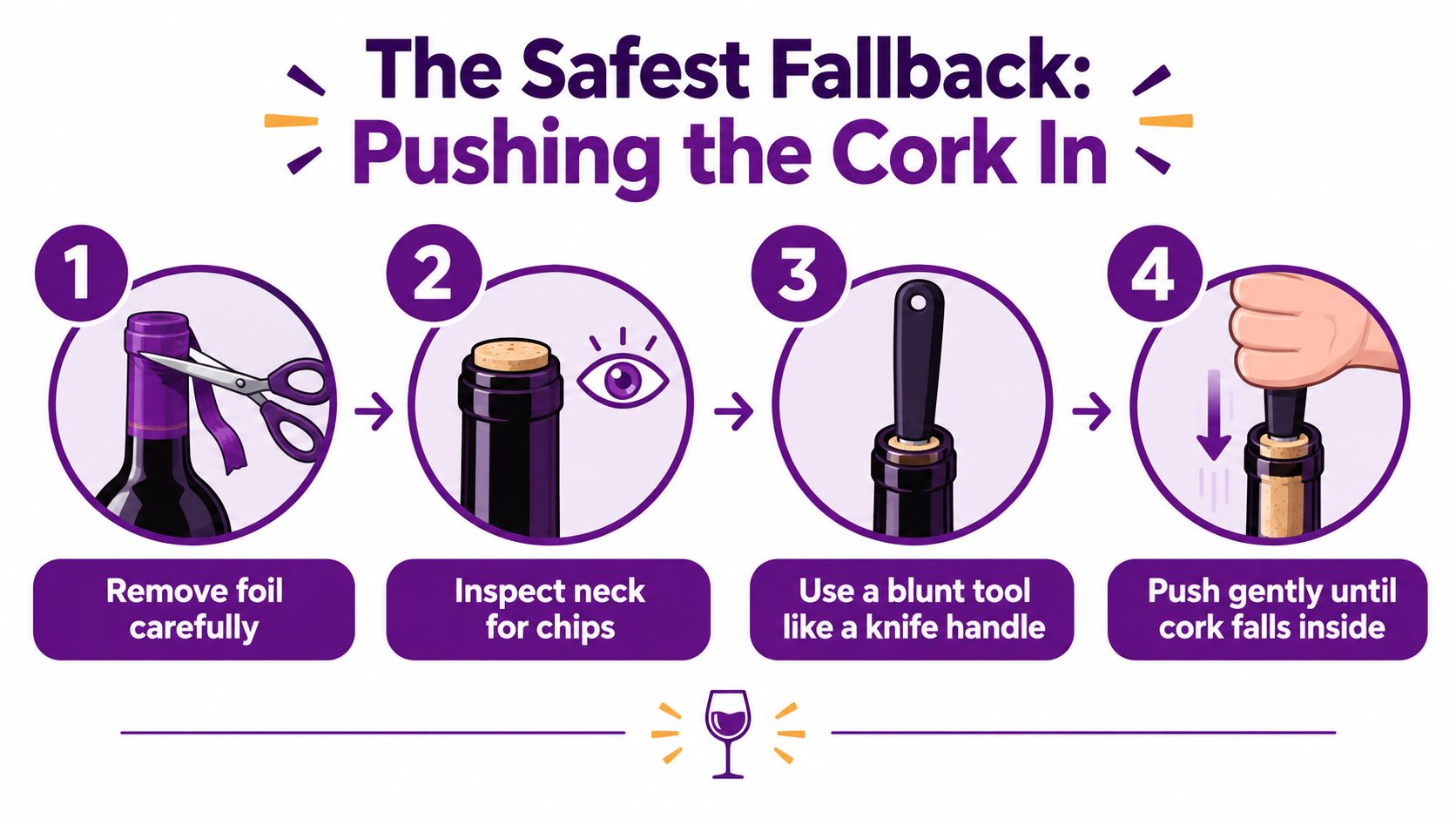
Pushing the cork inside is generally less likely to shatter the bottle than striking or heating it, but it can splash wine, leave cork in the bottle, and make pouring difficult, as explained in this history of the corkscrew and cork removal.
Clean up the pour
If the cork stays mostly intact, pour slowly. Keep the bottle steady and leave the final cloudy or fragment-filled portion behind if necessary.
If the cork breaks, don't keep trying to extract it. Push the remaining material into the bottle with the blunt tool, then pour through a clean fine-mesh strainer or decanting filter. Avoid shaking the bottle, since movement spreads small pieces through the wine. A clean filter is a much better solution than using a sharp object to fish around the neck.
For a practical guide to handling the wine after opening, use these steps for decanting red wine. Cork fragments are a quality problem, not a reason to panic. Broken glass is different. If the bottle neck is damaged or you suspect glass entered the wine, don't serve it.
Closest Substitute to a Real Corkscrew, Screw and Pliers
Have a screwdriver, a clean coarse-threaded screw, and pliers? This is usually the best option when you want the cork out instead of in the bottle.
Remove the foil and check the bottle neck before starting. Keep the bottle upright on a stable surface. Drive the screw into the center of the cork with a screwdriver, but don't send it all the way through. The screw should penetrate roughly 50% to 75% of the cork, leaving enough of the head exposed for pliers or a hammer claw.
The screw needs a real grip. Too shallow, and it can pull free. Too deep, and it may pierce the bottom of the cork and push material into the wine. Keep the bottle stationary and pull from the bottle base, never by bracing against the neck.
Grip the exposed screw head firmly. Pull straight upward, slowly. A slight rocking motion can help release the cork, but don't jerk sideways. The method is most controllable when the force stays vertical, which is why expert guidance on screw-and-pliers opening favors a steady upward pull.
The screw is only half the solution. Your control comes from keeping the bottle still and pulling without a sudden yank.
Stop immediately if the cork starts crumbling, splitting, or sliding around the screw. Switch to the push-in method instead of chasing fragments with a tool. If pieces fall into the wine, let the bottle settle and pour through a clean fine strainer. Never keep pulling harder just because the cork is almost out. “Almost” is exactly when a weak cork can lose its grip.
This technique works because it recreates the central action of a corkscrew. A threaded metal piece anchors in the cork, then upward force removes the cork and screw together. It isn't a trick. It's basic mechanics, used carefully.
The Shoe Method, How It Works and When to Skip It
The shoe method is the internet's favorite emergency stunt for a reason. A padded heel protects the bottle base while repeated impacts send pressure through the wine and gradually move the cork outward. That doesn't make it the safest choice.
Remove the foil. Wrap the bottle base in a folded towel, then place it inside the padded heel of a sturdy shoe. A flat, firm sole is preferable to a very soft sneaker. Hold the bottle horizontally or slightly upward-tilted against a solid, flat wall. Keep the bottle pointed away from people.
Tap the shoe heel against the wall with controlled, evenly spaced impacts. Check the cork after every few taps. Stop as soon as enough cork protrudes to grip by hand, then pull it out gently.
Never use this method with:
- Damaged glass: Cracks or chips can worsen under impact.
- Sparkling wine: Pressure changes the risk completely.
- Thin-walled bottles: They have less tolerance for repeated force.
- Hard, brittle surfaces: Brick and similarly unforgiving walls give you less control.
- Aggressive swings: A hard strike defeats the point of using repeated low-energy impacts.
The shoe method can work, but it has a narrower safety margin than pushing the cork in or using a screw and pliers. Published how-to guidance recommends a real corkscrew whenever one is available, and precise success rates or glass-failure percentages aren't supported by an identifiable independent laboratory study. Treat viral demonstrations as demonstrations, not safety benchmarks. The shoe method guidance supports controlled use while making that limitation clear.
Leave More Confident Than You Arrived
The practical takeaway is simple. Check the bottle first, use the lowest-force method, and stop when the situation stops looking controlled. For an intact still-wine bottle, gently pushing the cork in is the broadest fallback. With a screw and pliers, slow vertical extraction gives you a cleaner result. The shoe method belongs at the back of the line, not at the top.
Improvised opening should stay a last resort. A proper corkscrew protects the wine, the bottle, and your hands, especially when the cork is old, dry, or fragile. Closure choice can also change the problem before it starts. Market analysis reports that screw caps are expanding at roughly 7.98% annually as wineries and consumers favor convenience and consistent closure performance, while natural cork represented about 43.95% of U.S. wine-packaging share in 2025. See the guide to building wine confidence for more practical ways to feel comfortable with the bottle in front of you.
If you want a simple next step, take the free wine quiz. It shows where your wine knowledge starts, without turning dinner into homework.
A to Wine gives you short daily wine lessons that take about 5 minutes, practice quizzes, and an AI sommelier for real questions about bottles, menus, and pairings. Visit A to Wine and build the kind of confidence that helps you choose the wine, open it, and enjoy it without the usual guesswork.