Old World vs New World Wine: Key Differences Explained
Old World and New World are historical and geographic shortcuts, not dependable tasting categories. They can tell you something about where a wine comes from and how it may be labeled, but they do not reliably tell you whether the wine will be lean or rich, earthy or fruity, simple or complex, or better or worse with food.
You're standing in a shop or scanning a restaurant list, and the bottle names are doing that annoying wine thing where they help less than they should. One label says Bordeaux, another says Malbec, and a server is waiting for an answer. The useful move is not to assume one bottle will taste "Old World" and the other "New World." The better move is to look for clues that actually predict what's in the glass: region, grape, vintage, producer, growing conditions, and winemaking choices.
When the Comparison Still Helps You Decide
How to Read the Label and Pick a Bottle
What the glass is likely to do with dinner
Old World Style, New World Style, and Food Pairing
Climate and Winemaking Rules That Shape Taste
| Better clue | What it can tell you |
|---|---|
| Region | Climate, local grapes, and broad style tendencies |
| Grape variety | Likely acidity, tannin, body, and aroma profile |
| Vintage | Growing-season conditions in that region, if you know how the year played out there |
| Producer | House style, farming approach, and production choices |
| Alcohol and notes on the label | Practical hints about body and ripeness |
| Winemaking | Oak, sweetness, texture, and overall feel |
Why Europe still sets the tone
Where the Two Wine Worlds Come From
Table of Contents
- What Old World and New World Wine Actually Mean
- Why the Stereotypes Developed
- What Actually Shapes How Wine Tastes
- How to Pair Wine With Food More Reliably
- How to Read the Label and Pick a Better Bottle
- When the Old World vs New World Comparison Still Helps
Old World vs New World Wine Taste and Style
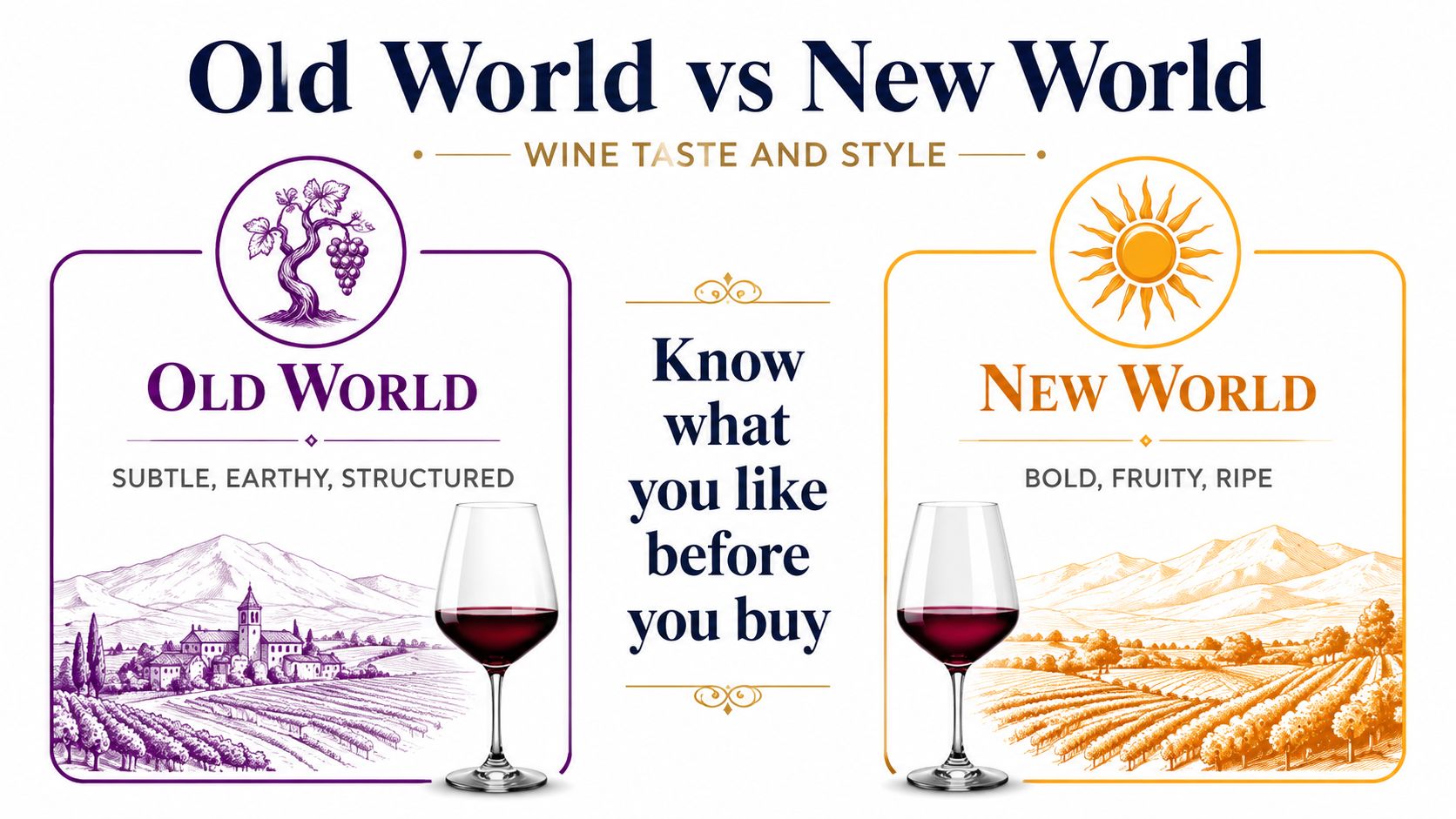
What Old World and New World Wine Actually Mean
The most accurate way to use these terms is simple. Old World usually refers to Europe and the historic wine regions around the Mediterranean, Caucasus, and Near East. New World usually refers to wine regions that rose to prominence outside that older core, including the Americas, Australia, New Zealand, and South Africa. These are common industry shortcuts, not formal scientific categories, and the edges are fuzzy.
The plain-English version
People often use Old World and New World as if they describe flavor. That's where the confusion starts. These terms describe historical context and geography first, not guaranteed taste. The geographic frame is the basic one most wine writers still use.
That said, the stereotypes did not come from nowhere. For a long time, many classic European regions were introduced to drinkers through region names, stricter appellation rules, and wines shaped by local tradition. Many newer export markets built recognition by putting the grape on the label and making wines that were easy for international buyers to understand. Those patterns were real, but they were never universal, and they still are not reliable enough to use as a shortcut for flavor, quality, or food pairing.
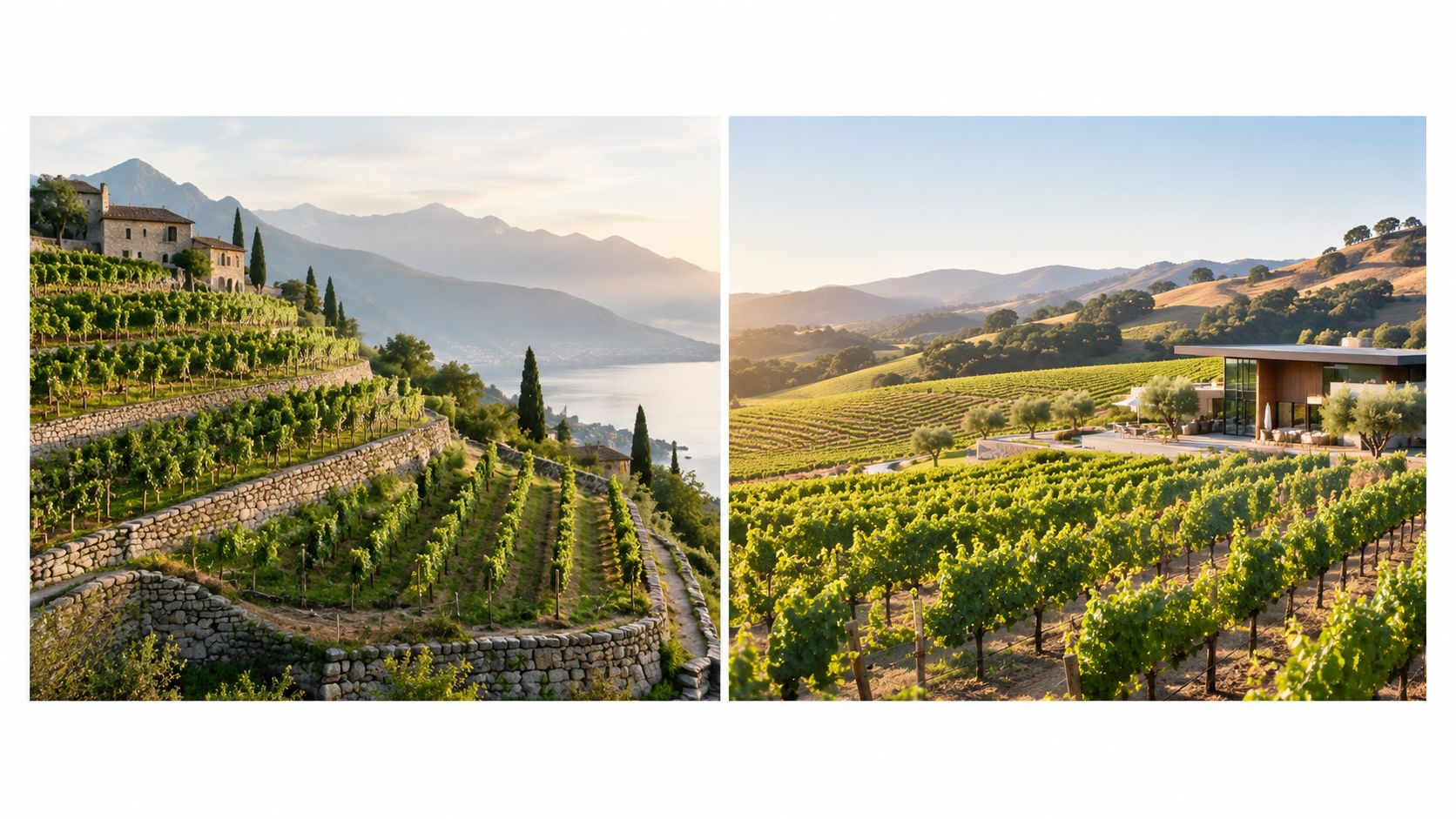
A better way to think about it is this: Old World and New World can help you understand where a wine fits historically, but if you want to predict the experience in the glass, you need to zoom in.
Why the Stereotypes Developed
The familiar story says Old World wines are restrained and savory, while New World wines are ripe and bold. That story survives because it once matched some broad export-era patterns, not because it is a dependable rule.
How history shaped the language
The language is tied to the spread of European vines, grape varieties, and winemaking practices through exploration, migration, and trade. Old World points back to long-established wine cultures in Europe and neighboring historic regions. New World became the conventional label for important wine-producing areas that developed outside that older center. That historical split still shapes modern expectations.
The key point is that this is not one neat timeline. Different regions developed at different speeds, under different climates, laws, and market pressures. The terminology is broad and informal, so it works best as background context, not as a tasting note.
Why the old shortcuts stuck around
The shortcuts lasted because they were convenient. If a label led with Bordeaux or Burgundy, buyers learned to think in terms of place. If a label led with Chardonnay or Cabernet Sauvignon, buyers learned to think in terms of grape. That still matters at the shelf, but it tells you more about how the wine is being presented than whether it will be lean, rich, acidic, oaky, or sweet.
A bottle from the Loire Valley and a bottle from Marlborough can both be Sauvignon Blanc, but the most useful comparison is not Old World versus New World. It is cooler site versus warmer site, producer style versus producer style, and one vintage versus another.
What Actually Shapes How Wine Tastes
If your goal is to choose a bottle you will actually enjoy, this is the section that matters most. Wine style is shaped by climate, grape variety, vineyard site, harvest timing, fermentation, oak, aging, and the producer's choices. Geography matters, but not in a simple two-box way.
Climate is real, but it is not the same as Old World or New World
Cooler growing conditions often help grapes keep higher acidity and fresher flavors. Warmer growing conditions often push grapes toward riper fruit character and fuller body. But cooler and warmer sites exist in both camps.
For example, Mosel in Germany and Champagne in France are classic cooler Old World regions. Cool-climate New World examples include Tasmania in Australia, the Sonoma Coast in California, and Willamette Valley in Oregon. On the warmer side, southern Spain and parts of Sicily are firmly Old World, while areas like Barossa Valley in Australia are familiar New World examples. Mendoza is more complicated because altitude and site vary widely, so broad warmth there does not erase important differences in freshness, ripeness, and structure from one area to another. The overlap is the point.
This is why Old World versus New World is a weak predictor of style on its own. A cool-climate Chardonnay from one so-called New World region may taste far more like a cool-climate Chardonnay from Burgundy than like a richer Chardonnay from a warmer region in the same country.
Alcohol, acidity, tannin, fruit, and sweetness are separate clues
A lot of wine confusion comes from grouping different traits together as if they always travel in a pack. They do not.
- Alcohol is influenced by grape sugar at harvest and how fermentation is carried out. Climate matters, but so do grape variety, picking decisions, and production choices. If you care about alcohol level, check the bottle's actual ABV instead of trying to infer it from Old World or New World.
- Acidity gives wine brightness and lift. A wine can be highly acidic whether it smells citrusy, floral, herbal, or tropical.
- Tannin creates that drying grip, especially in red wines. Tannin depends heavily on grape variety, skin contact, stem use, extraction, and oak handling.
- Fruit character describes aroma and flavor. A wine can smell very ripe and still be completely dry.
- Residual sugar is actual sugar left in the wine after fermentation. Fruity does not automatically mean sweet.
- Body is the wine's weight and texture in the mouth. Alcohol, sugar, extract, and winemaking can all affect it.
This matters because a wine can be intensely fruity and highly acidic, or light in body but tannic, or aromatic yet bone dry. Once you separate those clues, shopping gets much easier.
Why producer and winemaking matter so much
Grape variety tells you a lot, but producer decisions can change the result dramatically. Harvest earlier and the wine may feel fresher. Harvest later and it may feel riper. Use more oak and you may get vanilla, toast, and a broader texture. Limit oak and the fruit or savory notes may show more clearly. Choose stainless steel, concrete, large old barrels, skin contact, lees aging, or malolactic fermentation, and the wine can shift again.
Old World regions can be highly innovative. New World regions can be deeply traditional. Some producers chase freshness and tension. Others want ripeness and texture. Those choices matter far more than the label category alone.
If you want a deeper look at why some wines taste sharp and others taste round, this guide on why wines taste different is a solid companion read.
How to Pair Wine With Food More Reliably
Food pairing works best when you match the structure and intensity of the wine to the dish. Geography can be interesting background, but it is not the best pairing tool.
Match the structure, not the geography
Start with a few practical questions.
- How acidic is the dish? Tomato sauce, vinaigrettes, lemon, and pickles usually want a wine with enough acidity to stay lively.
- How much fat or protein is there? Rich meat, butter, and cheese can handle more tannin and body.
- Is the dish sweet? A wine that is less sweet than the food can taste sharp or thin. Off-dry wines often work better with sweet glazes or spicy heat.
- How spicy is it? High alcohol can make chili heat feel hotter. Lower alcohol and a little sweetness can help.
- How intense is the sauce or dominant ingredient? Sauce matters more than the protein in many pairings. Cream sauce, herb sauce, pepper sauce, and barbecue sauce all push you in different directions.
A few reliable examples help more than geography-based rules:
- High-acid wines often work well with tomato-based dishes, goat cheese, and vinaigrettes.
- Tannic reds often work better when there is enough fat and protein to soften the grip.
- Off-dry or slightly sweet wines can be excellent with spicy food, salty food, or dishes with sweet glaze.
- Match the wine's weight to the dish's richness and its flavor intensity to the dominant ingredients and seasonings.
- Delicate wines tend to do better when the dish is not dominated by smoke, sugar, or heavy chili heat.
The goal is not to memorize dozens of rules. It is to notice the wine's acidity, tannin, sweetness, alcohol, body, and flavor intensity, then compare those traits with the dish's salt, fat, acid, sweetness, and heat.
| Pairing clue | What to look for |
|---|---|
| Acidity | Great with acidic foods, fried foods, and dishes that need lift |
| Tannin | Better with protein and fat than with delicate fish or strong chili heat |
| Sweetness | Helpful with spice, salt, and sweet sauces or glazes |
| Alcohol | Higher alcohol can feel heavier and can amplify heat |
| Body | Match the wine's weight to the dish's richness so one does not overwhelm the other |
| Flavor intensity | Match the wine's intensity to the dish's dominant ingredients and seasonings |
If you want a simple pairing habit, focus on the sauce and the structure before the country of origin. Here's a useful pairing refresher if you want to get faster at this.
How to Read the Label and Pick a Better Bottle
Start with the label, but read it for specific clues, not for a two-team identity. If the front says Burgundy, Rioja, or Bordeaux, the producer is emphasizing place. If the front says Chardonnay, Malbec, or Cabernet Sauvignon, the producer is emphasizing grape. That difference is one of the cleanest shortcuts in wine shopping.
A fast way to decode what you're seeing
- Read the first big word. Is it a place, a grape, or a producer name?
- Check the vintage. Cooler, warmer, easier, and harder years can all change the wine.
- Look for region details. A broad country label tells you less than a specific valley, village, or appellation.
- Check the ABV. It is one of the quickest clues to possible body and ripeness.
- Check label terms in their regional context. Reserve, Estate, and Grand Cru have different meanings and are not interchangeable indicators of style or quality.
- Use the back label when it helps. Oak, dryness, texture, and pairing notes can all be useful, even if they are simplified.
A better same-grape test
Sauvignon Blanc is still a useful comparison, but not because one bottle is automatically Old World in style and the other New World in style. A Sancerre or Pouilly-Fumé Sauvignon Blanc from the Loire may lean herbal, citrusy, and tense. Many Marlborough Sauvignon Blancs show more passion fruit or tropical aroma. These Loire wines and many Marlborough examples are still dry and high in acidity, so intense fruit aromas do not imply sweetness or low acidity. But either place can produce wines that break the stereotype depending on site and producer.
The lesson is better than the binary: compare the same grape across specific regions and producers, then notice what changes. That habit teaches you much more than memorizing a map divided into two camps. This label-reading guide can help if you're tired of guessing in the aisle.
When the Old World vs New World Comparison Still Helps
The old split still has some value, but the value is limited. It helps explain how wine language developed, why some labels foreground place while others foreground grape, and why certain market stereotypes became popular. What it does not do well is predict flavor, quality, or food pairing with much precision. That shift is exactly why simple two-box explanations keep falling short.
What the terms are still good for
Use these terms as broad background, not as your main buying tool. They are helpful when you are learning wine history or label conventions. They are much less helpful when you are trying to predict whether a bottle will be crisp or round, floral or savory, oaked or unoaked, dry or sweet.
A more reliable first pass is this: start with grape, region, vintage, producer, and ABV, then confirm with the label description or a trusted shop note.
Best use: treat Old World and New World as context, then make your decision from the wine's specific clues.
A better way to learn wine
Try two wines side by side, but choose them by grape and growing conditions, not by a broad historical label alone. For example, compare two Sauvignon Blancs from cooler regions, or two Syrahs from warmer regions, and pay attention to acidity, tannin, body, alcohol, aroma, and sweetness level. That kind of comparison builds real confidence fast.
If you want a structured, low-stress way to build that instinct, start with A to Wine. The lessons are short, the quizzes are quick, and the AI sommelier is handy when you're standing in front of a shelf or a menu and want a straight answer.