What Is a Good Cabernet Sauvignon: The Confidence Test
Have you ever called a Cabernet Sauvignon “bad” because it felt harsh, hot, or too oaky, only to wonder later whether you just chose the wrong style? A good Cabernet Sauvignon isn't defined by maximum power. It's defined by balance, especially the way acidity, tannin, and alcohol work together in your mouth.
Table of Contents
- Why You Might Be Judging a Good Bottle Unfairly
- The Three Pillars of Balance in Red Wine
- How to Identify Real Quality Through Tannins and Ripeness
- Regional Differences and What They Mean for Your Glass
- The Simple Balance Test You Can Use Today
- Busting Common Myths About Good Cabernet
- How to Build Your Confidence With Every Glass
Why You Might Be Judging a Good Bottle Unfairly
A friend pours a deep red Cabernet with dinner. The first sip feels drying. The alcohol warms the back of the throat, and the oak tastes louder than the fruit. “I guess I don't like Cabernet,” they say.
That conclusion may be too fast. Cabernet Sauvignon is naturally structured. It has firm tannin, black-fruit character, and enough backbone to develop with age. Its high tannin comes partly from the grape's skins, seeds, and flesh, so a young bottle can feel more gripping than expected. UC Davis explains Cabernet Sauvignon's naturally high tannin content.
The important distinction is between boldness and balance. A wine can taste intensely of blackberry, cedar, vanilla, or dark chocolate and still feel awkward. Big flavor doesn't automatically mean good winemaking. Likewise, a Cabernet with less obvious sweetness or oak can be excellent if its structure feels connected.
Taste beyond the flavor list
Instead of asking, “Do I taste cassis?” ask three more useful questions:
- Does the wine feel fresh?
- Does the tannin create pleasant grip or painful dryness?
- Does the alcohol support the fruit, or does it stick out?
Those questions separate personal preference from technical quality. You might dislike a high-tannin Cabernet and still recognize that its parts fit together. Or you might love a powerful bottle while noticing that it feels hot and heavy.
Practical rule: You don't need to enjoy every Cabernet to judge whether it's balanced.
Cabernet's reputation comes from a long history of producing structured, ageworthy reds. Researchers at UC Davis used DNA typing in 1996 to show that Cabernet Sauvignon is the natural offspring of Cabernet Franc and Sauvignon Blanc, resolving a long-running question about its origin. Historical evidence places it in France by the 17th century, with Bordeaux as its strongest early center, before it spread to places including Tuscany, Chile, and California. Read the documented history of Cabernet Sauvignon.
The Three Pillars of Balance in Red Wine
Think of a Cabernet as a house. Acidity is the foundation, tannin is the structure, and alcohol is the body and warmth. A strong house needs all three. If one overwhelms the others, the wine feels disjointed.
Acidity keeps the wine moving
Acidity creates freshness. It makes your mouth water and keeps dark fruit from tasting dull or heavy. You may notice it along the sides of your tongue, especially when the wine finishes with a clean, lively sensation.
A Cabernet with too little acidity can feel flat, even if it has rich fruit. Too much acidity can make it seem sharp or thin. You don't need to measure it. Just notice whether the wine refreshes your mouth after you swallow. For a more detailed sensory explanation, use this guide to identifying acidity in wine.
Tannin gives the wine grip
Tannin is the drying, slightly rough sensation that gathers around your gums and teeth. It comes mainly from grape skins, seeds, and stems, along with contact with materials such as oak during winemaking.
Cabernet is naturally tannic. That grip can make the wine feel substantial and help it develop over time. Fine tannin feels like a gentle tightening or a soft, powdery texture. Coarse tannin feels scratchy, bitter, or aggressively drying.
Alcohol adds weight and warmth
Alcohol contributes body. You may feel it as warmth in your throat or a fuller texture across your tongue. Moderate-to-high alcohol can work beautifully when ripe fruit, acidity, and tannin keep it in proportion.
Quality Cabernet commonly falls around 13% to 15% ABV, with medium-plus to high acidity, according to this Cabernet Sauvignon structure guide. The number alone doesn't decide quality. A wine at either end of that range can work if the alcohol feels integrated rather than hot.
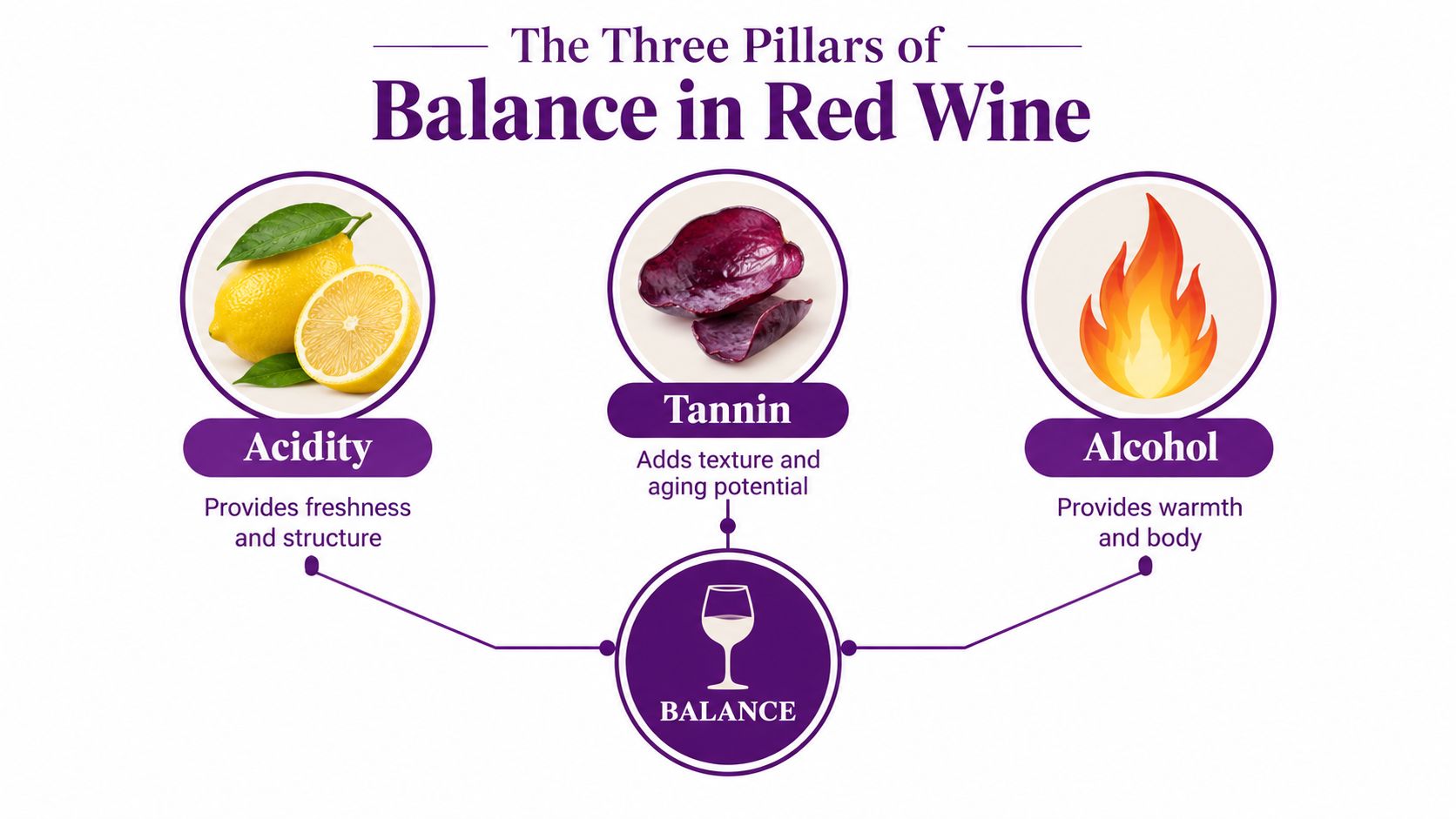
A balanced bottle doesn't make you identify each pillar separately forever. With practice, you feel the combined result. The wine has energy, shape, and warmth, but no single element shouts over the rest.
How to Identify Real Quality Through Tannins and Ripeness
Tannin confuses almost everyone at first. Some drinkers assume that more drying means more expensive or more serious. It doesn't. Harsh tannin isn't a quality score.
Cabernet quality often depends on phenolic maturity, a technical phrase for how fully the grape's skins and seeds have ripened. Underripe fruit can produce green, bitter, or harsh tannins. When the fruit reaches fuller phenolic maturity, the wine tends to show deeper color, smoother structure, and less punishing astringency. This explanation of Cabernet flavors, tannin, and phenolic ripeness describes why harvest timing matters so much.
Use your gums as a tasting tool
Take a small sip and hold it in your mouth for a moment. Swallow, then press your tongue against your gums.
- Fine tannin: Your gums feel gently tightened, almost like velvet or fine cocoa powder.
- Green tannin: The wine tastes bitter, leafy, or sharply astringent.
- Aggressive tannin: Your mouth feels stripped, and the dryness dominates the finish.
- Balanced tannin: The grip is clear but pleasant, and the fruit remains present.
Don't judge the wine from the first second alone. Cabernet can be firm when first poured and soften with air. Taste again after the wine has rested in the glass. If the fruit becomes clearer while the tannin remains supportive, that's a useful sign.
Look for ripe fruit, not sweetness
A ripe Cabernet doesn't have to taste sweet. It can taste like blackcurrant, blackberry, plum, herbs, cedar, or savory earth while remaining dry. The key is whether the fruit feels developed enough to support the wine's tannin and alcohol.
Young Cabernet often combines black fruit and herbal notes with firm tannin and high acidity. With maturity, tannins can soften while the flavor profile moves toward cedar, tobacco, earth, soy, and cocoa. This consumer guide to Cabernet Sauvignon outlines that general shift.
Listen to your gums, not just your nose. Your mouth will tell you whether the structure feels polished or unfinished.
Regional Differences and What They Mean for Your Glass
Cabernet changes with its growing place. Climate affects how quickly grapes ripen, how much freshness remains, and how much body the finished wine carries. Region won't tell you everything, but it gives you a useful first guess.
Bordeaux often points toward structure, freshness, and savory or herbal detail. Napa Valley is more associated with ripe black fruit, fuller body, and a richer impression. Chile can offer ripe fruit with freshness, depending on the site and winemaking choices. These aren't rigid rules. They're starting points for choosing a style that fits your palate.
Read the label as a style clue
A bottle from a cooler or maritime-influenced region may show more acidity, herbal notes, and restrained fruit. A warmer region may produce riper black fruit, more body, and a warmer finish. Neither approach wins automatically.
Climate change is making this comparison more important. Recent coverage describes warmer vintages pushing some Cabernet wines above 16% ABV, while producers respond by picking earlier, choosing higher-altitude sites, and aiming for wines closer to 13.0% to 13.5% ABV. This overview of changing Cabernet styles connects those choices with shifts toward more approachable Bordeaux and more savory, earthy Napa styles.
Try this at a restaurant. If you want freshness with steak, ask for a Cabernet from a cooler or maritime setting. If you want a dense, plush glass beside grilled beef, choose a warmer-climate style. Then apply the same balance test to both.
A little regional history explains Cabernet's broad appeal. By 2015, about 341,000 hectares were planted worldwide, making it the most widely planted wine grape at that time. It now appears across major regions including France, the United States, Chile, Australia, South Africa, Italy, Spain, Argentina, and China. Explore Cabernet Sauvignon's global importance.
The Simple Balance Test You Can Use Today
Pour the Cabernet and take one normal sip. Don't swirl it into a performance. Just notice what happens.
- Does your mouth water? That's acidity creating freshness.
- Do your gums dry pleasantly? That's tannin adding grip and shape.
- Does the warmth sit smoothly? That's alcohol contributing body without taking over.
Give the wine another sip after a short rest in the glass. A good Cabernet may be firm, but its fruit, freshness, and tannin should feel connected. If the alcohol burns, the tannin feels bitter, or the acidity makes the wine seem sour, one pillar may be dominating.
The test doesn't ask whether the wine is powerful. It asks whether the wine is coherent. A lighter-feeling Cabernet can pass beautifully if it stays fresh and structured. A massive Cabernet can fail if the warmth and oak bury the fruit.
The best bottle is the one whose parts cooperate in your mouth.
Use the test when ordering by the glass, comparing regions, or opening a bottle with dinner. Beef can soften the impression of firm tannin, while a simple weeknight meal may favor a Cabernet with more freshness and less weight.
Busting Common Myths About Good Cabernet
Myth one: bigger means better. A dark color, heavy body, strong oak, and high alcohol can make a first sip impressive. They don't guarantee balance. Oak contact can increase phenols, vanillic acid, gallotannins, and color intensity in Cabernet Sauvignon, as described in this study of oak contact and Cabernet composition. Oak changes the wine, but it can't replace ripe fruit or lively acidity.
Myth two: price tells you everything. Price can shape expectations, but it isn't a perfect shortcut for sensory quality. Wine economics research has found that price effects depend on context and the drinker, while quality signals such as competition results, expert scores, and retail price don't always move together for Cabernet Sauvignon. Read the research on price and perceived wine quality.
A balanced bottle at a modest price may suit dinner better than an aggressive showpiece. Choose for the occasion, not the label's attempt to impress you.
How to Build Your Confidence With Every Glass
The next time you drink Cabernet, write down three words: freshness, grip, warmth. You don't need a tasting notebook filled with fruit names. Note whether each quality felt pleasant, excessive, or missing.
For example, one bottle might feel fresh and savory with firm tannin. Another might taste plush but warm. A third might show bright acidity and soft grip. None of those observations requires expert vocabulary. They give you useful information about what you'd order again.
Practice the Balance Test at a shop tasting, a restaurant, or your own kitchen table. If you want more simple tools for making choices without second-guessing yourself, explore how to build wine confidence.
You already have enough information to start. Taste the wine, notice the structure, and trust the pattern you feel more than the marketing language on the bottle.
A to Wine gives you short daily wine lessons that take about five minutes, practice quizzes, and an AI sommelier for real questions about bottles, menus, and pairings. Visit A to Wine and turn the Balance Test into a skill you can use with every glass.