What Makes Wine Dry and How to Read Any Label
Forget the popular advice that dry means sugar-free. What makes wine dry is mostly how little sugar is left after fermentation, plus how acidity, tannin, and texture change what you taste. Learn those three pieces and labels stop feeling like a trick.
Table of Contents
- The Short Answer Nobody Tells You
- Residual Sugar and How Fermentation Shapes It
- Legal Definitions and the Acidity Loophole
- Tannin and Why Reds Feel Dry Even When They Are Not
- Why Two Wines With the Same Sugar Can Taste Different
- Reading Labels When the Word 'Dry' Gets Confusing
- Picking a Bottle You Will Actually Enjoy
The Short Answer Nobody Tells You
People use dry for three different experiences and assume they're the same thing. They're not. That's why you can order a dry wine, take a sip, and think, wait, this tastes fruity. Or juicy. Or weirdly soft.
You're not tasting it wrong. The word is doing too much work.
Three Meanings of 'Dry' in Wine
| Meaning | What It Describes | How You Notice It | Example Style |
|---|---|---|---|
| Analytical dryness | Low residual sugar, the sugar left after fermentation | Little or no sweetness on the finish | Dry Sauvignon Blanc |
| Tannin dryness | A puckering, grippy texture, mainly in reds | Your mouth feels dried out, like strong tea | Cabernet Sauvignon |
| Perceived dryness | The overall balance of acid, alcohol, fruit, and body | One wine feels crisp, another feels round | Two Rieslings with equal sugar |
That middle row trips up almost everyone. A red can feel mouth-drying because of texture even when sugar isn't the story at all.
The top row trips people up in the opposite way. Fruity is not the same as sweet. A wine can smell like ripe peach or cherry and still have very little sugar left. Your nose reads fruit. Your tongue reads sugar. Those are different signals.
Practical rule: When you say dry, ask yourself which dry you mean, no sweetness, grippy texture, or a crisp finish.
Once you split the word into those three jobs, you can order with more precision. You can also read a label without memorizing legal thresholds you'll forget by dinner.
Residual Sugar and How Fermentation Shapes It
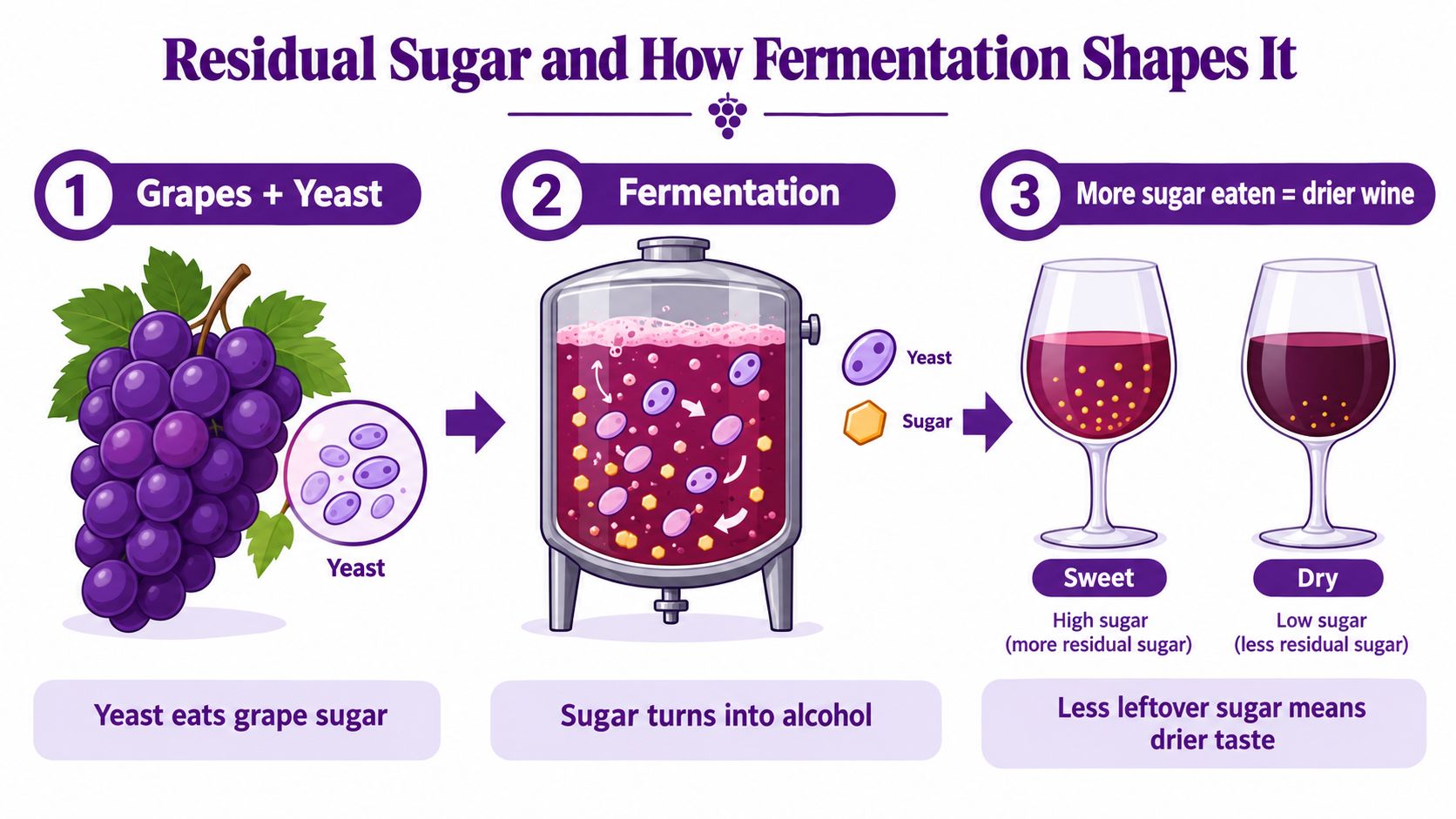
Fermentation is yeast eating dinner. Grapes bring the sugar, yeast consumes it, and whatever it leaves behind is what you taste. The more sugar yeast eats, the less ends up in your glass, and the drier the wine feels.
That leftover sugar has a name: residual sugar, often shortened to RS. Winemakers measure it in grams per liter, and the numbers are small enough to surprise anyone who assumes dry means zero.
What Yeast Actually Does
A university fermentation lab describes primary fermentation as lasting about one week, with most juice sugar converted to ethanol while carbon dioxide escapes as a byproduct, in its guide to wine fermentation. You don't need the chemistry degree. You need the cause and effect.
- Fermentation runs to the end: Yeast eats nearly all fermentable sugar. The wine tastes dry.
- Fermentation stops early: Sugar remains. The wine tastes sweeter.
- Grapes start very ripe: There's more sugar to begin with, so yeast has more work to do.
Dry rarely means zero, either. Dry table wines commonly contain about 1 to 4 g/L of residual sugar, according to research on wine yeast and fermentation. A trace amount can soften a wine without registering as sweet on your tongue. That alone dismantles the assumption that dry and sugar-free are the same thing.
Why the Same Grape Can Taste Different
Winemakers steer this outcome at several points. They choose when to pick, which yeast strain to pitch, and how warm the tank runs. They can also stop fermentation on purpose to keep some sweetness.
So two bottles made from the same grape can land far apart. One comes out crisp and lean, the other softer and rounder. The grape didn't change its personality. The amount of sugar left behind did.
Legal Definitions and the Acidity Loophole
Labels aren't just vibes. In major markets, dry carries a legal meaning tied to residual sugar. That number is the first of the three experiences hiding behind the word: measurable sweetness on paper. The catch is that acidity can bend the rule, which makes sense once you taste it.
Under the OIV standard, a still wine is dry at no more than 4 g/L of residual sugar, with an extension to 9 g/L when acidity is high enough, as set out in the OIV standard for dry wine. Why allow more sugar? Because acid makes sweetness harder to notice.
Lemonade shows why: add more lemon and the same spoonful of sugar tastes less sweet. Wine works the same way. Two bottles can sit on opposite sides of the 9 g/L line and taste almost identical if one carries enough acid to hide the difference.
Numbers Worth Keeping on Your Phone
| Term for Still Wine | Residual Sugar |
|---|---|
| Dry | Up to 4 g/L, or 9 g/L with high acidity |
| Medium dry | Up to 12 g/L, or 18 g/L with high acidity |
| Sweet | Starts at 45 g/L |
Those medium dry and sweet thresholds come from the EU labeling rules for wine sugar terms. You don't need to memorize the table. Screenshot it before a shop trip and you'll already read labels better than most shoppers guessing in the aisle.
A wine with more sugar but sharp acidity can taste drier than a low-acid wine with less sugar.
How to Use This at a Restaurant
You probably won't see grams per liter on a menu. You'll see grape, region, and style words. Use acidity as your clue. Wines described as crisp, bright, or zippy often carry the acid that makes small amounts of sugar disappear on your palate.
If you want help spotting that snap in the glass, this walkthrough on how to identify wine acidity gives you a simple tasting check. Look for mouthwatering. If your mouth waters after a sip, acid is doing real work.
One warning. A tiny measurement difference near a threshold can change a category. Don't treat the legal line as a flavor guarantee. It tells you where a wine sits on paper. Your palate still gets the final vote.
Tannin and Why Reds Feel Dry Even When They Are Not
Red wine confuses this topic more than any other style. People sip a big red, feel their mouth pucker, and call it dry. That feeling usually isn't sugar talking. It's texture.
Tannin is a compound from grape skins, seeds, and sometimes oak. In plain words, it's the stuff that makes your mouth feel grippy and a little rough. It interacts with proteins in your saliva, so your mouth feels less lubricated.
The Tea Bag Test
Picture black tea that's steeped too long. It's bitter, drying, and it seems to grab the inside of your cheeks. You didn't add anything dry to the cup. The tea just extracted more tannin.
Red wine works the same way because the juice spends time with the skins. More skin contact and thicker skins usually mean more tannin. White wines are typically pressed away from skins early, so they rarely give you that same sandpaper feeling.
- Pinot Noir: Usually thinner skins, softer grip, a smoother finish.
- Cabernet Sauvignon: Usually thicker skins, stronger grip, a longer drying feeling.
That contrast isn't just opinion. In a 2019 sensory study, panelists perceived Cabernet Sauvignon as drier than Pinot Noir and that dryness lasted longer, as reported in research on tannin and perceived dryness. The researchers linked the effect to larger tannins and higher tannin concentration.
Dry Versus Drying
Say those two words separately in a shop and you'll get better help. If you dislike the puckering feeling, don't ask for a less dry red. Ask for a lower tannin or softer red.
If you want the longer version, this explainer on what tannin means in wine breaks down where that grip comes from. The short version fits on an index card. Sugar decides sweetness. Tannin decides grip.
Why Two Wines With the Same Sugar Can Taste Different
Put two wines side by side with identical residual sugar. One can taste crisp and dry. The other can taste soft and almost sweet. Nothing is broken. Your palate isn't reading a lab report, it's reading balance.
These factors push perception around the most.
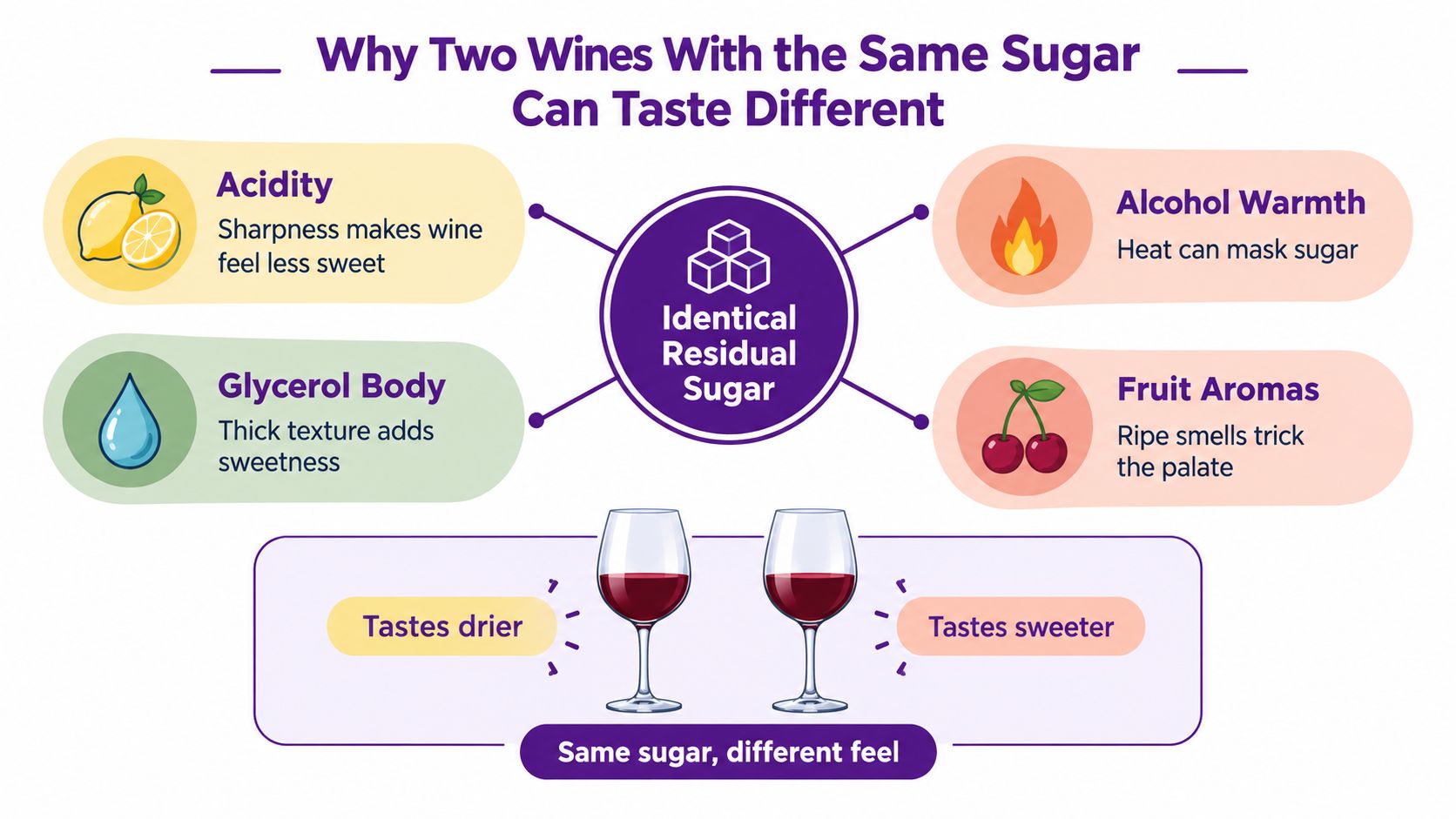
Virginia Tech describes sweetness as a balance between sugar-like sensations and acidity, astringency, and bitterness in its material on wine sweetness and balance. Lower the acid or the grip, and the same wine can seem sweeter.
- Acidity: Sharpness cuts sweetness, like lemon on berries.
- Alcohol: Warmth and body can read as a soft, sweet impression.
- Glycerol: This adds a smooth, slightly thick texture that can feel round.
- Fruit aromas: Ripe smells suggest candy to your brain even when sugar is low.
Temperature matters too. Serve a white cold and it usually feels crisper and drier. Let it warm up in the glass and fruit and softness step forward. Same wine, same sugar, different impression.
Watch how those pieces interact in a real glass comparison.
If you enjoy chasing that puzzle, read more on why wines taste different from one bottle to the next. The lesson for ordering is simple. Don't chase a number. Chase the balance you like.
Reading Labels When the Word 'Dry' Gets Confusing
Sparkling wine is where labels get sneaky. Extra dry sounds like the driest choice on the shelf. It isn't. In sparkling wine, extra dry sits sweeter than brut.
Compare still and sparkling terms before you buy.
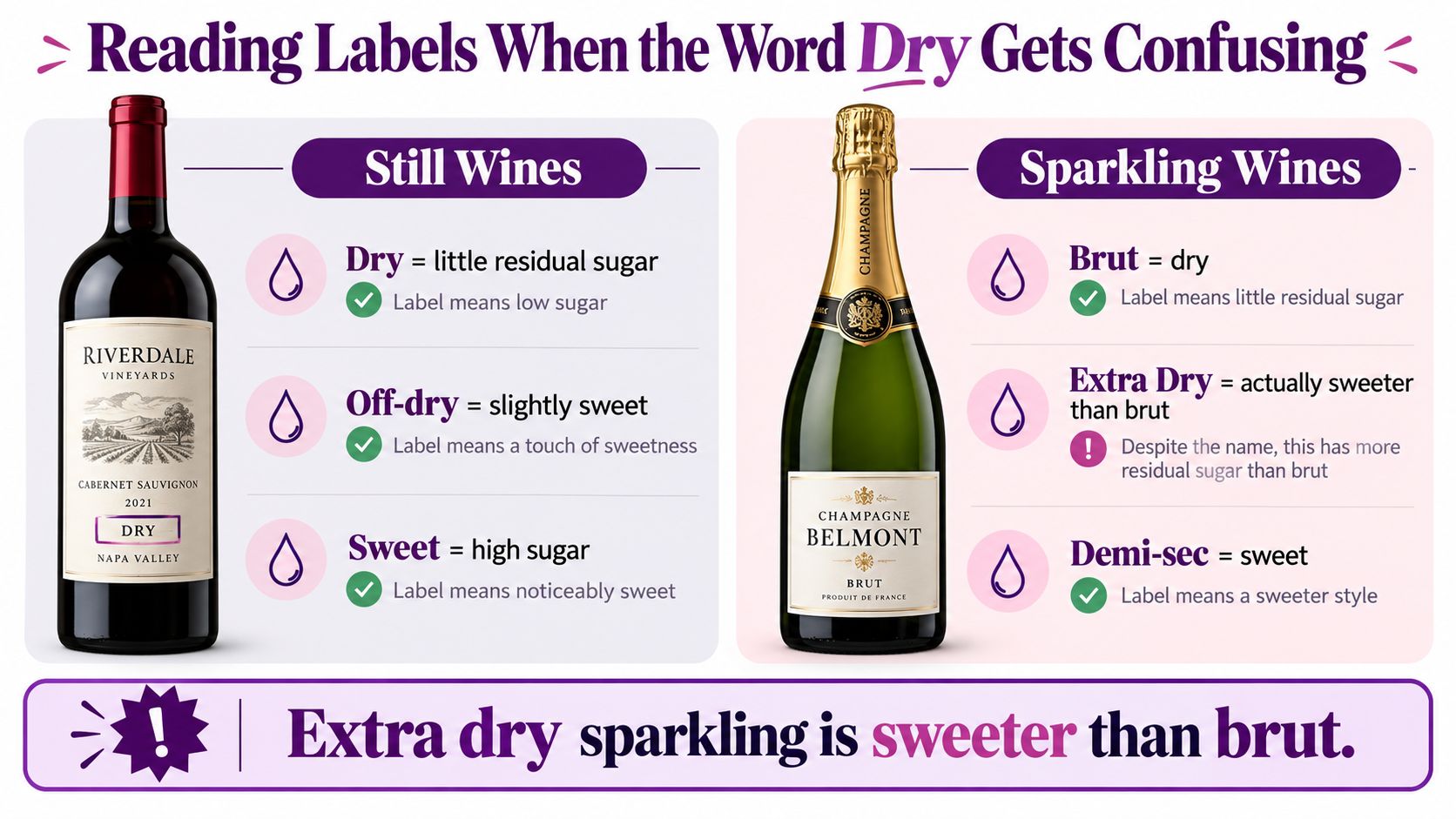
For still wine, dry means little sugar, off-dry means a slight sweetness, and sweet means you'll notice it clearly. For sparkling, brut is the safer pick when you want a dry style. Extra dry gives you a softer edge.
Foreign words add another layer. You may see sec or Trocken on imported bottles. Don't panic and don't guess from how fancy the font looks. Check the style, the grape, and any back label description. If a shop lists residual sugar online, even better.
Low and no alcohol wines deserve the same skepticism. Removing alcohol can change body and balance, so a bottle can taste sweeter even without much sugar, a point explored in Wine Enthusiast on the confusion around dry and sweet. Alcohol percentage alone won't tell you dryness. Taste and label terms together will.
Picking a Bottle You Will Actually Enjoy
Use three quick questions before you buy. Do you want no sweetness, do you like or dislike grippy texture, and are you eating something rich, salty, or spicy? Those answers beat chasing the word dry alone.
Want crisp and clean? Pick a high acid white or a brut sparkling. Want smooth red without the pucker? Pick Pinot Noir over Cabernet. Want a personalized starting point, take the free A to Wine quiz and build from styles you already like.
If dry versus drying still feels blurry in a shop aisle, A to Wine turns ideas like residual sugar, acidity, and tannin into short daily lessons that take about 5 minutes, with practice quizzes and an AI sommelier for real bottle questions. Join 5,700+ happy learners learning at a 4.9/5 average rating and follow a personalized, ongoing wine path built around what you taste.