What Wine to Drink with Salmon: A Simple Pairing Guide
High-acid white wines like Chablis or Sauvignon Blanc are the safest bet for most salmon, and 2,817,200 tonnes of global supply in 2023 shows you're dealing with a major food category, not a niche one (FAO data). Grilled and smoked salmon open the door to red and sparkling options, but the trick is matching the wine to the way the fish is cooked.
You're standing at a restaurant table or opening the fridge at home, staring at salmon and a wine shelf that all starts to blur together. Skip the old “white with fish” rule. With salmon, preparation matters more than color.
Table of Contents
- The Short Answer to What Wine to Drink with Salmon
- Why Acidity Is Your Best Pairing Tool
- How Cooking Method Changes Everything
- Pairing Salmon by Preparation Style
- The Case for Red Wine with Fish
- Your Practical Salmon Pairing Checklist
The Short Answer to What Wine to Drink with Salmon
If the salmon is cooked plainly, go straight to a high-acid white. Chablis, Sauvignon Blanc, dry Riesling, and cool-climate Chardonnay are the safest, cleanest choices because salmon's rich texture needs freshness, not more heaviness (FAO pairing guidance, food pairing guidance).
If the fish is grilled, roasted, or cedar-planked, you've got more room. A fuller Chardonnay works well, and a light Pinot Noir can absolutely make sense when smoke and browning show up on the plate (salmon pairing guidance, Pinot Noir with salmon).
If it's smoked or cured, I'd reach for sparkling wine first. The acidity handles the salt and oil, and the bubbles keep the whole thing from feeling dense (pairing guidance, smoked salmon guidance).
My blunt rule
Match the wine to the strongest thing on the plate.
If the strongest thing is lemon and herbs, go lean and bright. If it's butter, cream, smoke, or char, give the wine more body.
That's the whole game. Stop shopping by grape name first. Start with how the salmon was cooked, then pick the wine that can keep up.
Why Acidity Is Your Best Pairing Tool
Salmon is oily, rich, and soft on the palate. That's why low-acid wine can make the meal feel flat. The fish doesn't just sit next to the wine, it changes how the wine tastes.
Acidity is the reset button. It cuts through the fat, clears the mouth, and makes the next bite feel fresh again. That's why crisp whites keep showing up in salmon pairings, from Chablis to Sauvignon Blanc to dry Riesling (FAO pairing guidance, acid and richness guidance).
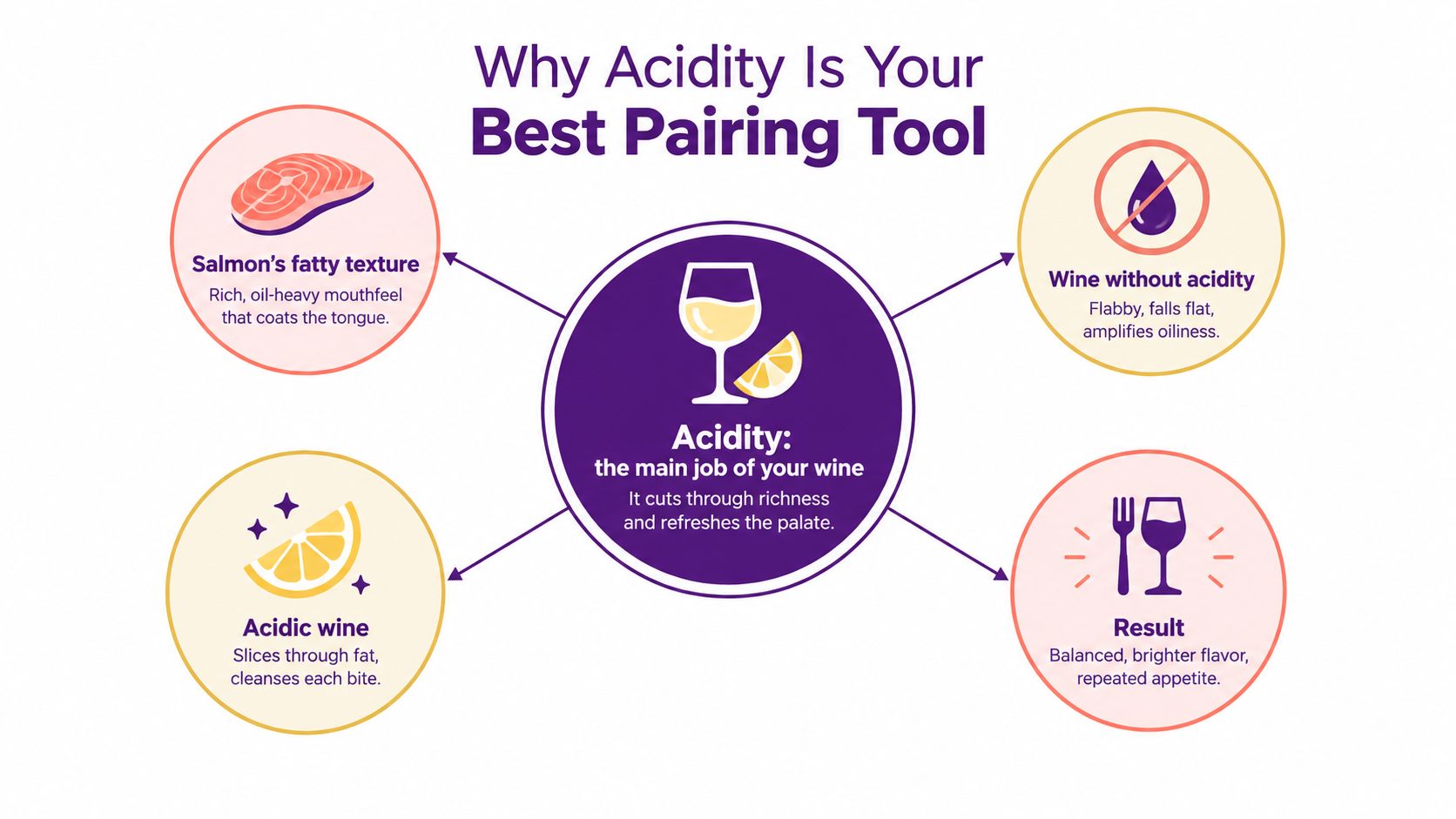
Think of acid as contrast, not decoration
A wine with enough acidity won't taste huge or buttery next to salmon. It'll taste alive. That's the point. You want a sip that wakes up your mouth between bites, not one that sinks under the fish.
A practical benchmark from pairing guidance is a crisp white in the rough range of 6–8 g/L total acidity, with wines like Chablis, Sancerre, Grüner Veltliner, or dry Riesling as reliable examples (acid benchmark guidance). That doesn't mean you need to measure anything at dinner. It just means you should favor wines that taste sharp, clean, and refreshing.
The wrong move is grabbing a soft, low-acid white and hoping for the best. With salmon, that usually makes the plate feel heavier, not smoother. Use acidity as the filter, and most bad pairings disappear fast.
Here's the one line worth remembering: the wine should feel at least as fresh as the dish.
How Cooking Method Changes Everything
Raw or lightly poached salmon lives in a different world from grilled salmon. The first one is delicate and subtle. The second one brings smoke, browning, and a little edge. If you use the same wine for both, you're guessing.
Light cooking wants lift
Poached, raw, or citrus-seasoned salmon wants a bright white with real nerve. Chablis, Sancerre, Sauvignon Blanc, and dry Riesling work because they add energy without burying the fish (poached salmon guidance, food pairing guidance). That's the cleanest match when the salmon is soft and the flavors are simple.
Heat and smoke want more structure
Grilling, roasting, and cedar-planking change the equation. You get a deeper, more savory dish, and that's where a fuller Chardonnay or a light red like Pinot Noir starts making sense (salmon guidance, Wine Folly on salmon). The wine has to stand beside the char, not hide from it.
Cream and butter are their own category. They add weight, so the wine needs enough body to stay in balance. An oak-aged Chardonnay can handle that job better than a skinny, low-acid white, especially when the sauce is doing the heavy lifting (flight wine guidance, Wine Folly on salmon).
The sauce matters as much as the fish.
Lemon and herbs want brightness. Cream and butter want body. Smoke and char can handle more tannin and more flavor.
The common mistake is treating salmon like one ingredient with one correct wine. It isn't. It's a method question. Cook it one way, and you want precision. Cook it another, and you want width.
Pairing Salmon by Preparation Style
Poached salmon is the easiest place to start. It's soft, moist, and mild, so lean white wines make the most sense. Sauvignon Blanc, Chablis, and dry Riesling bring the freshness that keeps the dish from feeling sleepy (poached salmon guidance).
If that poached salmon comes with creamy dill or lemon sauce, move up in weight. A fuller Chardonnay is the better call because the sauce adds richness that the leanest whites can't always cover (poached salmon guidance, flight wine guidance). Don't underbuy the wine just because the fish looks delicate.
Grilled or cedar-planked salmon is where people get brave. They should. The smoke and char give you permission to use Pinot Noir, as long as it's light-bodied and low in tannin, or a fuller white with enough texture to keep up (Lovetoknow salmon guidance, Winetraveler on Pinot Noir). Pinot works because its bright fruit and low tannin don't fight the fish oils.
Smoked salmon is the strongest case for sparkling wine. A dry Champagne or crisp Prosecco works because acidity cuts the salt and bubbles add lift, which keeps the combo from tasting heavy (smoked salmon guidance, food pairing guidance). If the salmon is cured or especially salty, sparkling wine is the first bottle I'd reach for.
A simple way to consider it:
- Poached or raw: bright white, very fresh
- Grilled or cedar-planked: fuller white or light red
- Smoked: sparkling wine first
- Creamy sauce: Chardonnay with enough body
That's the version I'd trust at a restaurant without overthinking it.
The Case for Red Wine with Fish
The old rule says fish means white wine. That rule is lazy. It's not wrong every time, but it's way too blunt for salmon.
Red wine works when the red is light, low in tannin, and fresh in fruit. Pinot Noir is the classic answer because it has enough acidity and not much tannin, so it won't clash with the fish oils (Pinot Noir with salmon, red wine guidance). Gamay fits the same basic idea. It stays juicy and doesn't stomp on the plate.
What to avoid
Heavily tannic reds are the problem. Young Cabernet Sauvignon and Nebbiolo can throw a bitter or metallic note when they meet fish oils (food pairing guidance, red wine guidance). That metallic effect is why a lot of people think red and fish never work. They just picked the wrong red.
Roasted or grilled salmon gives red wine enough support to make sense. The smoke, browning, and deeper savory flavors let a light red stay relevant instead of fading into the background (red wine guidance, Pinot Noir with salmon). You're not pairing red wine with fish in the abstract. You're pairing it with a specific cooked dish.
forget pinot, your salmon craves a chilled beaujolais
If you want the short version, buy Pinot Noir before you buy anything bigger. It's the safest red for salmon because it stays light on its feet.
Your Practical Salmon Pairing Checklist
Start with the cooking method. That's the key decision point, not the word “salmon” on the menu. Raw and poached need brightness. Grilled and roasted need more shape. Smoked needs lift.
Then look at the sauce or glaze. Lemon and herbs pull you toward lean whites. Cream, butter, and rich glazes push you toward fuller Chardonnay. Soy, miso, and teriyaki can also handle wines with more fruit and personality, as long as the wine still has enough freshness to avoid feeling sweet or heavy.
Use this quick filter
- If it's delicate, choose precision. Go for Chablis, Sauvignon Blanc, or dry Riesling.
- If it's smoky or browned, choose shape. Try Chardonnay or Pinot Noir.
- If it's salty or cured, choose bubbles. Sparkling wine is the cleanest move.
- If you're choosing red, respect tannin. Stick with light reds and avoid aggressive ones.
The biggest mistake is picking a wine just because it's white. Salmon doesn't care about that rule. It cares about balance. The wine has to meet the dish where it is, not where a generic pairing chart says it should be.
For a broader way to think about dinner pairings, this guide on how to pair wine with food without guessing fits the same logic. Start with the food's weight, then pick the wine that matches it.
Final rule: if the wine tastes softer than the salmon, it's the wrong bottle.
Use that test and you'll stop second-guessing yourself in the aisle and at the table.
If you want a smarter way to pick wine for dinner without memorizing a bunch of grape names, A to Wine gives you short daily wine lessons, quick practice quizzes, and an AI sommelier that can help you choose the right bottle for salmon or anything else on the menu. It's built for exactly this kind of confidence, fast.